Tiếng Anh lớp 10 · KNTT · Chương 12
Lý thuyết Tiếng Anh 10 Unit 9 · Language (Rhythm, Environment & Reported speech)
Tổng hợp toàn bộ kiến thức cốt lõi phần Language - Unit 9: Protecting the environment (Tiếng Anh 10 Kết nối tri thức), gồm quy tắc tạo nhịp điệu câu (Rhythm), từ vựng chủ đề môi trường và ngữ pháp câu tường thuật (Reported speech).
1. Trang sách giáo khoa
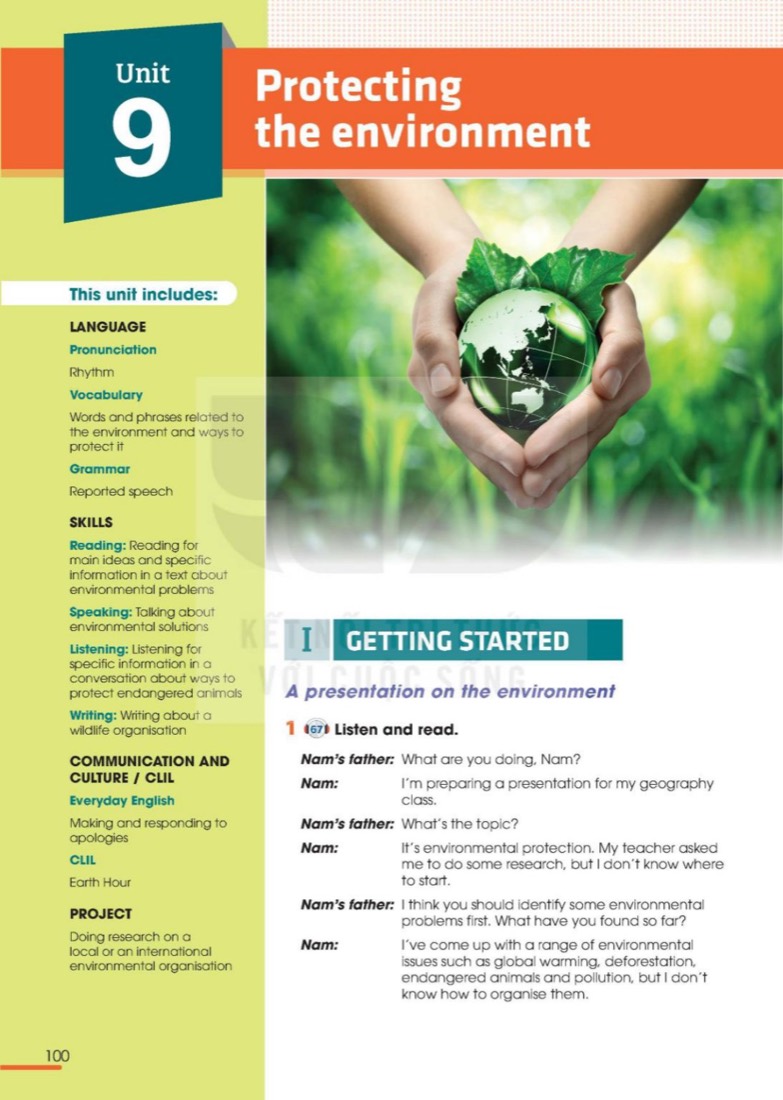
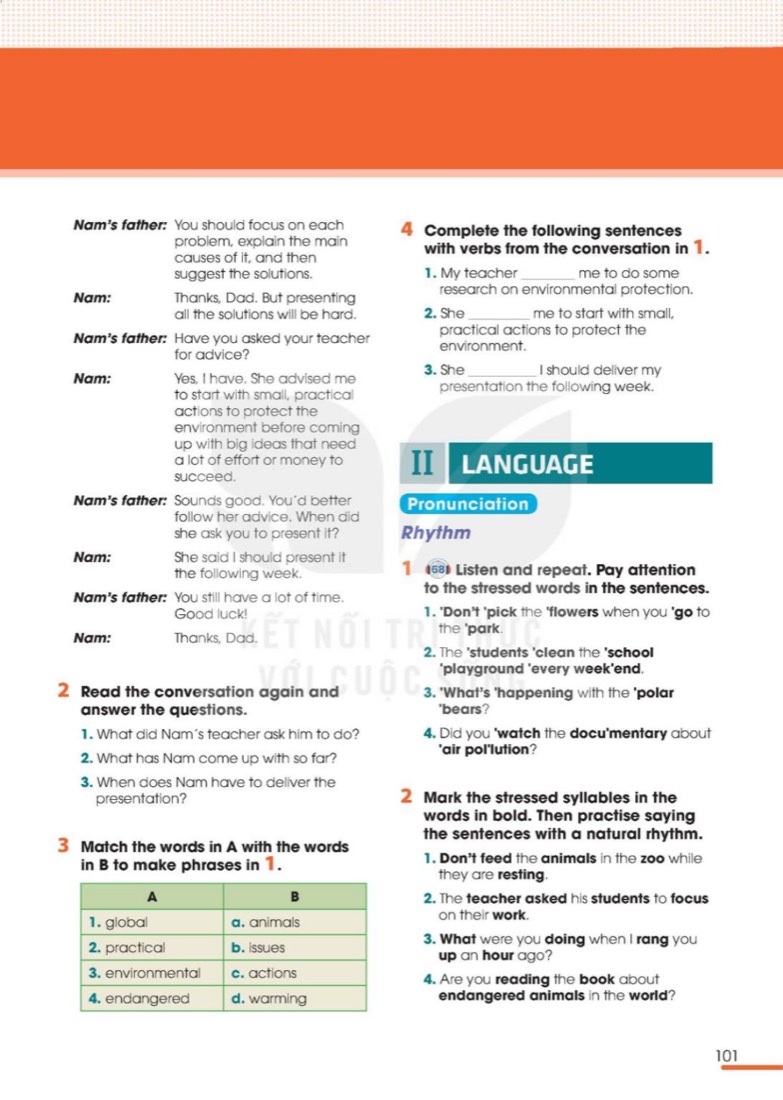
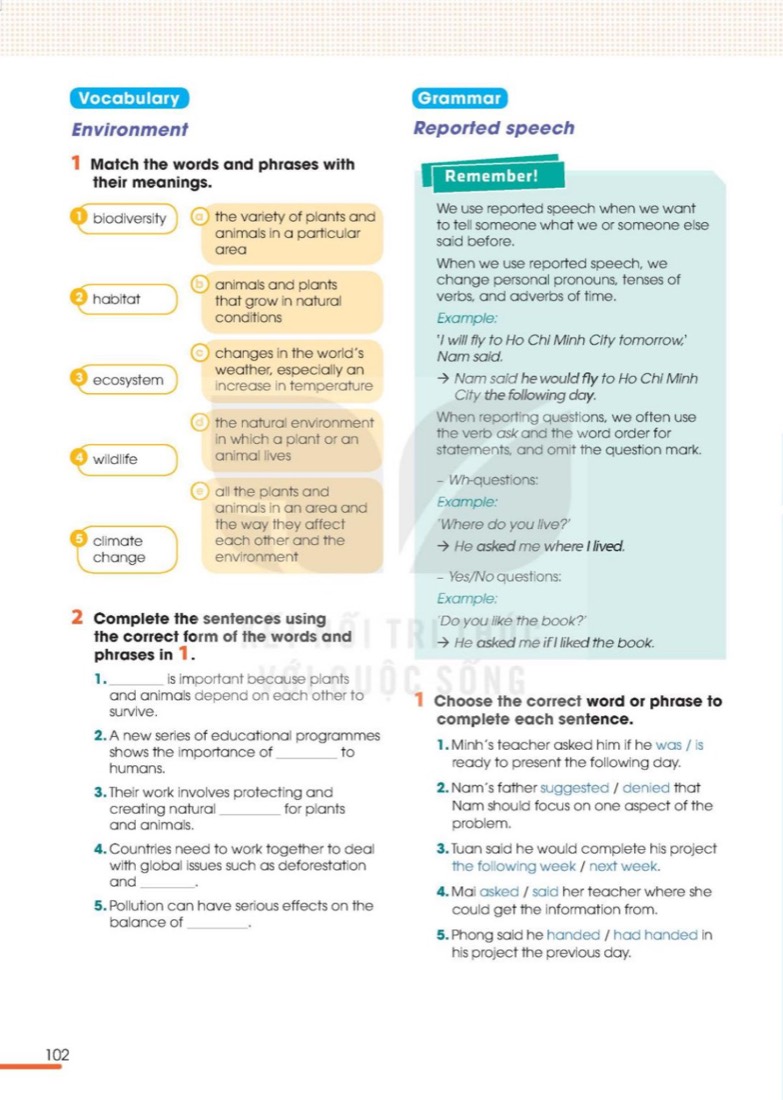
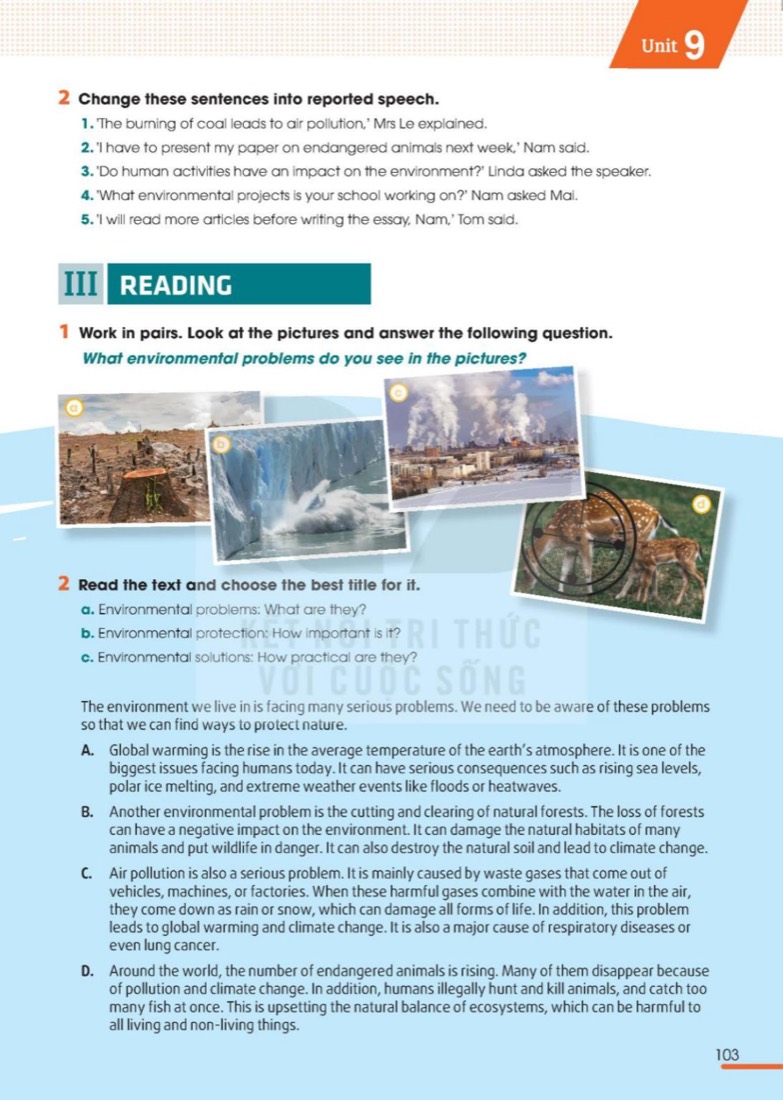
2. Ngữ âm: Nhịp điệu trong câu (Rhythm)
Trong tiếng Anh, nhịp điệu (Rhythm) được tạo nên bởi sự luân phiên giữa các từ được nhấn trọng âm (stressed words) và từ không được nhấn trọng âm (unstressed words). Tiếng Anh là ngôn ngữ căn theo nhịp trọng âm (stress-timed language), khoảng cách thời gian giữa các âm tiết mang trọng âm thường tương đương nhau.
Quy tắc nhận biết từ được nhấn và không được nhấn:
- Từ mang nội dung (Content words) — THƯỜNG ĐƯỢC NHẤN TRỌNG ÂM: Gồm danh từ (flowers, park, students), động từ chính (pick, go, clean), tính từ (polar), trạng từ, từ để hỏi (what, where), trợ động từ phủ định (don't).
- Từ mang chức năng ngữ pháp (Structure / Function words) — THƯỜNG KHÔNG NHẤN: Gồm mạo từ (a, an, the), giới từ (to, about, with), đại từ nhân xưng (you, he), liên từ (when, and), trợ động từ khẳng định (did, are).
Ví dụ minh họa từ SGK:
- 'Don't 'pick the 'flowers when you 'go to the 'park.
(Nhấn vào: Don't, pick, flowers, go, park - các từ cung cấp thông tin chính của câu). - The 'students 'clean the 'school 'playground 'every week'end.
- 'What's 'happening with the 'polar 'bears?
- Did you 'watch the docu'mentary about 'air pol'lution?
3. Từ vựng trọng tâm: Môi trường (Environment)
Dưới đây là các từ vựng và thuật ngữ then chốt xuất hiện trong bài học về chủ đề bảo vệ môi trường:
| Từ vựng / Cụm từ | Phiên âm IPA | Từ loại | Định nghĩa tiếng Anh & Nghĩa tiếng Việt | Câu ví dụ minh họa |
|---|---|---|---|---|
| biodiversity | /ˌbaɪəʊdaɪˈvɜːsəti/ | n. | the variety of plants and animals in a particular area (sự đa dạng sinh học) | Biodiversity is important because plants and animals depend on each other to survive. |
| habitat | /ˈhæbɪtæt/ | n. | the natural environment in which a plant or an animal lives (môi trường sống tự nhiên) | Their work involves protecting and creating natural habitats for plants and animals. |
| ecosystem | /ˈiːkəʊsɪstəm/ | n. | all the plants and animals in an area and the way they affect each other and the environment (hệ sinh thái) | Pollution can have serious effects on the balance of ecosystems. |
| wildlife | /ˈwaɪldlaɪf/ | n. | animals and plants that grow in natural conditions (động thực vật hoang dã) | A new series of educational programmes shows the importance of wildlife to humans. |
| climate change | /ˈklaɪmət tʃeɪndʒ/ | n. phr. | changes in the world's weather, especially an increase in temperature (biến đổi khí hậu) | Countries need to work together to deal with global issues such as deforestation and climate change. |
| deforestation | /diːˌfɒrɪˈsteɪʃn/ | n. | the cutting and clearing of natural forests (nạn phá rừng) | Countries need to work together to deal with global issues such as deforestation and climate change. |
| air pollution | /eə pəˈluːʃn/ | n. phr. | contamination of the indoor or outdoor air (ô nhiễm không khí) | The burning of coal leads to air pollution. |
| endangered animals | /ɪnˈdeɪndʒəd ˈænɪmlz/ | n. phr. | animals that are at risk of extinction (động vật có nguy cơ tuyệt chủng) | He will present his paper on endangered animals next week. |
Lưu ý: 5 từ đầu tiên (biodiversity, habitat, ecosystem, wildlife, climate change) có định nghĩa theo bài tập Vocabulary của SGK. Ba từ còn lại (deforestation, air pollution, endangered animals) là từ bổ sung xuất hiện trong các bài tập/phần ngữ âm; định nghĩa chỉ mang tính tham khảo.
4. Ngữ pháp chuyên sâu: Câu tường thuật (Reported Speech)
Chúng ta sử dụng câu tường thuật (Reported speech) khi muốn thuật lại cho ai đó biết bản thân hoặc người khác đã nói điều gì trước đó.
1. Ba quy tắc biến đổi cốt lõi
Khi đổi từ câu trực tiếp sang câu gián tiếp, ta cần biến đổi 3 yếu tố:
- Đổi đại từ nhân xưng, tính từ sở hữu và đại từ sở hữu: Biến đổi linh hoạt theo người nói và người nghe (ví dụ: I → he/she, my → his/her, we → they).
- Lùi thì của động từ (Tense backshift):
- Hiện tại đơn (V/V-s/es) → Quá khứ đơn (V2/ed)
- Hiện tại tiếp diễn (am/is/are + V-ing) → Quá khứ tiếp diễn (was/were + V-ing)
- Hiện tại hoàn thành (have/has + V3/ed) → Quá khứ hoàn thành (had + V3/ed)
- Quá khứ đơn (V2/ed) → Quá khứ hoàn thành (had + V3/ed)
- Tương lai đơn (will + V) → Tương lai trong quá khứ (would + V)
- have to / must → had to; can → could
- Đổi từ chỉ thời gian và nơi chốn:
- now → then
- today → that day
- yesterday → the previous day / the day before
- tomorrow → the following day / the next day
- next week → the following week / the next week
- here → there; this → that; these → those
2. Cấu trúc câu tường thuật trần thuật (Statements)
Công thức: S + said (that) + S + V (lùi thì)
hoặc: S + told + O + (that) + S + V (lùi thì)
Ví dụ trong bài:
'I will fly to Ho Chi Minh City tomorrow,' Nam said.
→ Nam said he would fly to Ho Chi Minh City the following day.
3. Cấu trúc câu tường thuật dạng câu hỏi (Questions)
Khi tường thuật câu hỏi, ta thường dùng động từ tường thuật ask, dùng trật tự từ như câu khẳng định (chủ ngữ đứng trước động từ: S + V), không dùng trợ động từ do/does/did và bỏ dấu chấm hỏi (?).
- Câu hỏi Wh-questions:
S + asked + (O) + Wh-word + S + V (lùi thì)
Ví dụ: 'Where do you live?' → He asked me where I lived. - Câu hỏi Yes/No questions:
S + asked + (O) + if / whether + S + V (lùi thì)
Ví dụ: 'Do you like the book?' → He asked me if I liked the book.
5. Hướng dẫn giải bài tập SGK chi tiết
Pronunciation
1. Listen and repeat. Pay attention to the stressed words in the sentences.
(Nghe và lặp lại. Chú ý đến các từ được nhấn trọng âm trong câu.)
- 1. 'Don't 'pick the 'flowers when you 'go to the 'park.
- 2. The 'students 'clean the 'school 'playground 'every week'end.
- 3. 'What's 'happening with the 'polar 'bears?
- 4. Did you 'watch the docu'mentary about 'air pol'lution?
2. Mark the stressed syllables in the words in bold. Then practise saying the sentences with a natural rhythm.
(Đánh dấu âm tiết được nhấn trong các từ in đậm. Sau đó luyện nói các câu với nhịp điệu tự nhiên.)
- 1. 'Don't 'feed the 'animals in the 'zoo while they are 'resting.
→ Đánh dấu: 'Don't, 'feed, 'an-i-mals, 'zoo, 'res-ting. - 2. The 'teacher 'asked his 'students to 'focus on their 'work.
→ Đánh dấu: 'teach-er, 'asked, 'stu-dents, 'fo-cus, 'work. - 3. 'What were you 'doing when I 'rang you up an 'hour a'go?
→ Đánh dấu: 'What, 'do-ing, 'rang, 'hour, a-'go. - 4. Are you 'reading the 'book about en'dangered 'animals in the 'world?
→ Đánh dấu: 'read-ing, 'book, en-'dan-gered, 'an-i-mals, 'world.
Vocabulary
1. Match the words and phrases with their meanings.
(Nối các từ và cụm từ với ý nghĩa tương ứng.)
- 1 - a: biodiversity — the variety of plants and animals in a particular area (đa dạng sinh học - sự phong phú các loài thực vật và động vật trong một khu vực cụ thể).
- 2 - d: habitat — the natural environment in which a plant or an animal lives (môi trường sống - môi trường tự nhiên nơi động thực vật sinh sống).
- 3 - e: ecosystem — all the plants and animals in an area and the way they affect each other and the environment (hệ sinh thái - toàn bộ thực vật, động vật trong vùng và cách chúng tác động lẫn nhau cùng môi trường).
- 4 - b: wildlife — animals and plants that grow in natural conditions (động thực vật hoang dã - các loài sinh trưởng trong điều kiện tự nhiên).
- 5 - c: climate change — changes in the world's weather, especially an increase in temperature (biến đổi khí hậu - những thay đổi của thời tiết toàn cầu, đặc biệt là sự gia tăng nhiệt độ).
2. Complete the sentences using the correct form of the words and phrases in 1.
(Hoàn thành các câu bằng dạng đúng của từ/cụm từ ở bài 1.)
- 1. Biodiversity is important because plants and animals depend on each other to survive.
(Giải thích: Cần danh từ làm chủ ngữ nói về sự đa dạng sinh học mà qua đó động thực vật phụ thuộc lẫn nhau). - 2. A new series of educational programmes shows the importance of wildlife to humans.
(Giải thích: "wildlife" chỉ giới động thực vật hoang dã nói chung đối với con người). - 3. Their work involves protecting and creating natural habitats for plants and animals.
(Giải thích: Đứng sau tính từ "natural" và nói về nhiều nơi cư trú tự nhiên cho nhiều loài nên dùng danh từ số nhiều "habitats"). - 4. Countries need to work together to deal with global issues such as deforestation and climate change.
(Giải thích: Cần một vấn đề toàn cầu đi cùng với nạn phá rừng "deforestation" → "climate change"). - 5. Pollution can have serious effects on the balance of ecosystems.
(Giải thích: Cụm từ "balance of ecosystems" nghĩa là sự cân bằng của các hệ sinh thái).
Grammar
1. Choose the correct word or phrase to complete each sentence.
(Chọn từ hoặc cụm từ đúng để hoàn thành mỗi câu.)
- Minh's teacher asked him if he was / is ready to present the following day.
→ Đáp án: was (Lùi thì từ hiện tại đơn sang quá khứ đơn theo mệnh đề tường thuật "asked"). - Nam's father suggested / denied that Nam should focus on one aspect of the problem.
→ Đáp án: suggested (Cấu trúc "suggest that S + should do sth": gợi ý ai nên làm gì; "denied" mang nghĩa phủ nhận). - Tuan said he would complete his project the following week / next week.
→ Đáp án: the following week (Trong câu gián tiếp, cụm trạng từ chỉ thời gian "next week" phải đổi thành "the following week"). - Mai asked / said her teacher where she could get the information from.
→ Đáp án: asked (Cấu trúc hỏi ai điều gì: "asked + O + Wh-word"; "said" không đứng trực tiếp trước tân ngữ người mà phải có "to"). - Phong said he handed / had handed in his project the previous day.
→ Đáp án: had handed ("the previous day" được chuyển từ "yesterday", hành động nộp bài đã diễn ra trước thời điểm nói nên lùi về thì quá khứ hoàn thành).
2. Change these sentences into reported speech.
(Chuyển các câu sau sang câu tường thuật.)
- 'The burning of coal leads to air pollution,' Mrs Le explained.
→ Mrs Le explained that the burning of coal led to air pollution.
(Lưu ý: Mệnh đề nói về một sự thật hiển nhiên/quy luật khoa học cũng có thể giữ nguyên thì hiện tại đơn: leads to air pollution). - 'I have to present my paper on endangered animals next week,' Nam said.
→ Nam said that he had to present his paper on endangered animals the following week / the next week.
(Đổi "I" → "he", lùi thì "have to" → "had to", "next week" → "the following week / the next week"). - 'Do human activities have an impact on the environment?' Linda asked the speaker.
→ Linda asked the speaker if / whether human activities had an impact on the environment.
(Câu hỏi Yes/No: mượn "if/whether", lùi thì "have" → "had", bỏ trợ động từ "Do" và bỏ dấu chấm hỏi). - 'What environmental projects is your school working on?' Nam asked Mai.
→ Nam asked Mai what environmental projects her school was working on.
(Câu hỏi Wh-question: giữ lại từ để hỏi "what environmental projects", chuyển trật tự từ thành khẳng định "her school was working on"). - 'I will read more articles before writing the essay, Nam,' Tom said.
→ Tom told Nam (that) he would read more articles before writing the essay.
(hoặc: Tom said to Nam that he would read more articles...; đổi "I" → "he", "will" → "would").
🌟 Em đã học (Ghi nhớ kiến thức trọng tâm)
- Ngữ âm: Nắm vững quy tắc tạo nhịp điệu (Rhythm) tự nhiên trong câu thông qua việc nhấn trọng âm vào các từ chứa nội dung (content words).
- Từ vựng: Ghi nhớ các thuật ngữ trọng tâm về môi trường như biodiversity, habitat, ecosystem, wildlife, climate change.
- Ngữ pháp: Nắm chắc cách chuyển đổi từ câu trực tiếp sang câu tường thuật (Reported speech) đối với câu trần thuật và hai dạng câu hỏi (Wh-questions & Yes/No questions).
- Kỹ năng: Luyện giải chi tiết các bài tập thực hành theo chuẩn SGK kèm phân tích ngữ pháp tỉ mỉ.