Tiếng Anh lớp 11 · KNTT · Chương 3
Lý thuyết Tiếng Anh 11 Unit 3 · Speaking (Discussing cities of the future)
Tổng hợp lý thuyết và hướng dẫn thực hành kỹ năng Nói (Speaking) Unit 3 môn Tiếng Anh 11 Global Success về chủ đề thành phố tương lai thông minh, bền vững và chiến thuật duy trì hội thoại bằng Wh-questions.
1. Trang sách giáo khoa
2. Đoạn hội thoại mẫu về giao thông tương lai (Activity 2)
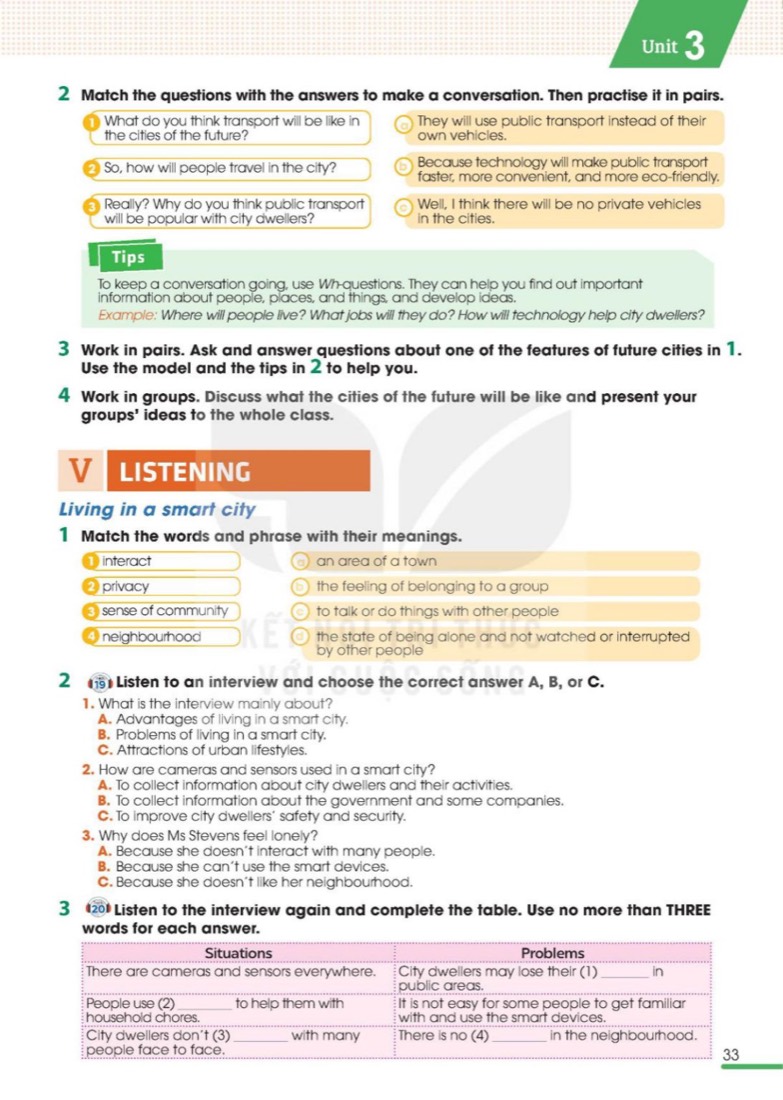
Dưới đây là nội dung đoạn hội thoại hoàn chỉnh từ bài tập 2 (trang 33 SGK) kèm bản dịch tiếng Việt đối chiếu, giúp học sinh nắm bắt ngữ cảnh và cách triển khai câu trả lời tự nhiên:
| Tiếng Anh (Original Conversation) | Bản dịch tiếng Việt |
|---|---|
| A: What do you think transport will be like in the cities of the future? | A: Bạn nghĩ giao thông sẽ như thế nào ở các thành phố tương lai? |
| B: Well, I think there will be no private vehicles in the cities. | B: Ồ, mình nghĩ sẽ không còn phương tiện cá nhân trong các thành phố. |
| A: So, how will people travel in the city? | A: Vậy thì người dân sẽ đi lại trong thành phố bằng cách nào? |
| B: They will use public transport instead of their own vehicles. | B: Họ sẽ sử dụng phương tiện giao thông công cộng thay vì phương tiện của riêng mình. |
| A: Really? Why do you think public transport will be popular with city dwellers? | A: Thật ư? Tại sao bạn lại nghĩ phương tiện giao thông công cộng sẽ phổ biến với cư dân thành phố? |
| B: Because technology will make public transport faster, more convenient, and more eco-friendly. | B: Bởi vì công nghệ sẽ làm cho giao thông công cộng nhanh hơn, thuận tiện hơn và thân thiện với môi trường hơn. |
3. Bảng từ vựng và cụm từ trọng tâm trong bài nói
Các từ vựng và cụm từ xuất hiện trực tiếp trong bài nói giúp các em xây dựng luận điểm mạch lạc khi thảo luận về thành phố tương lai:
| Từ vựng / Cụm từ | Phiên âm IPA | Từ loại | Nghĩa tiếng Việt | Câu ví dụ trong bài |
|---|---|---|---|---|
| private vehicle | /ˈpraɪvət ˈviːəkl/ | n.phr | phương tiện cá nhân | There will be no private vehicles because people will use public transport. |
| public transport | /ˌpʌblɪk ˈtrænspɔːt/ | n.phr | phương tiện giao thông công cộng | Why do you think public transport will be popular with city dwellers? |
| green skyscraper | /ɡriːn ˈskaɪskreɪpə(r)/ | n.phr | tòa nhà chọc trời xanh (thân thiện với môi trường) | Green skyscrapers will replace old blocks of flats and offices in crowded urban centres. |
| urban centre | /ˈɜːbən ˈsentə(r)/ | n.phr | trung tâm đô thị | ...in crowded urban centres. |
| sensor technology | /ˈsensə tekˈnɒlədʒi/ | n.phr | công nghệ cảm biến | Smart street infrastructure with sensor technology will provide information for faster, cheaper, and better decision-making. |
| living conditions | /ˈlɪvɪŋ kənˈdɪʃnz/ | n.phr | điều kiện sống | Living conditions in smart cities will be much better. |
| eco-friendly | /ˌiːkəʊ ˈfrendli/ | adj | thân thiện với môi trường | Eco-friendly public transport will produce less carbon dioxide or waste... |
| city dweller | /ˈsɪti ˈdwelə(r)/ | n.phr | cư dân thành phố | How will technology help city dwellers? |
| AI technology | /ˌeɪ ˈaɪ tekˈnɒlədʒi/ | n.phr | công nghệ trí tuệ nhân tạo | People's lives will be easier because AI technologies will help them do many daily activities. |
| decision-making | /dɪˈsɪʒn meɪkɪŋ/ | n | việc ra quyết định | ...will provide information for faster, cheaper, and better decision-making. |
4. Kỹ thuật giao tiếp: Duy trì cuộc trò chuyện bằng câu hỏi Wh-questions (Tips)
Chiến thuật duy trì hội thoại (Conversation Tips):
Trong giao tiếp tiếng Anh, để giữ cho cuộc trò chuyện tiếp diễn và không bị ngắt quãng, ta sử dụng Wh-questions (câu hỏi có từ để hỏi). Chúng giúp tìm hiểu thông tin quan trọng về con người, địa điểm, sự vật và mở rộng ý tưởng.
- Where (Ở đâu): Tìm hiểu về nơi chốn.
Ví dụ trong sách: Where will people live? (Mọi người sẽ sống ở đâu?) - What (Cái gì, làm gì): Tìm hiểu về hành động, công việc, sự vật.
Ví dụ trong sách: What jobs will they do? (Họ sẽ làm những công việc gì?) - How (Như thế nào, bằng cách nào): Khai thác phương thức, cách thức hoạt động.
Ví dụ trong sách: How will technology help city dwellers? (Công nghệ sẽ giúp ích cho cư dân thành phố như thế nào?) - Why (Tại sao): Khai thác nguyên nhân, lý do.
Ví dụ trong bài đối thoại: Why do you think public transport will be popular with city dwellers? (Tại sao bạn nghĩ giao thông công cộng sẽ phổ biến với cư dân thành phố?)
Cấu trúc ngữ pháp dự đoán tương lai thường dùng:
- Câu hỏi:
Wh-word + will + S + V-inf...? - Câu trả lời / nêu ý kiến:
I think / Well, I think + S + will + V-inf...hoặcThere will be + N...
5. Hướng dẫn chi tiết giải bài tập SGK Speaking
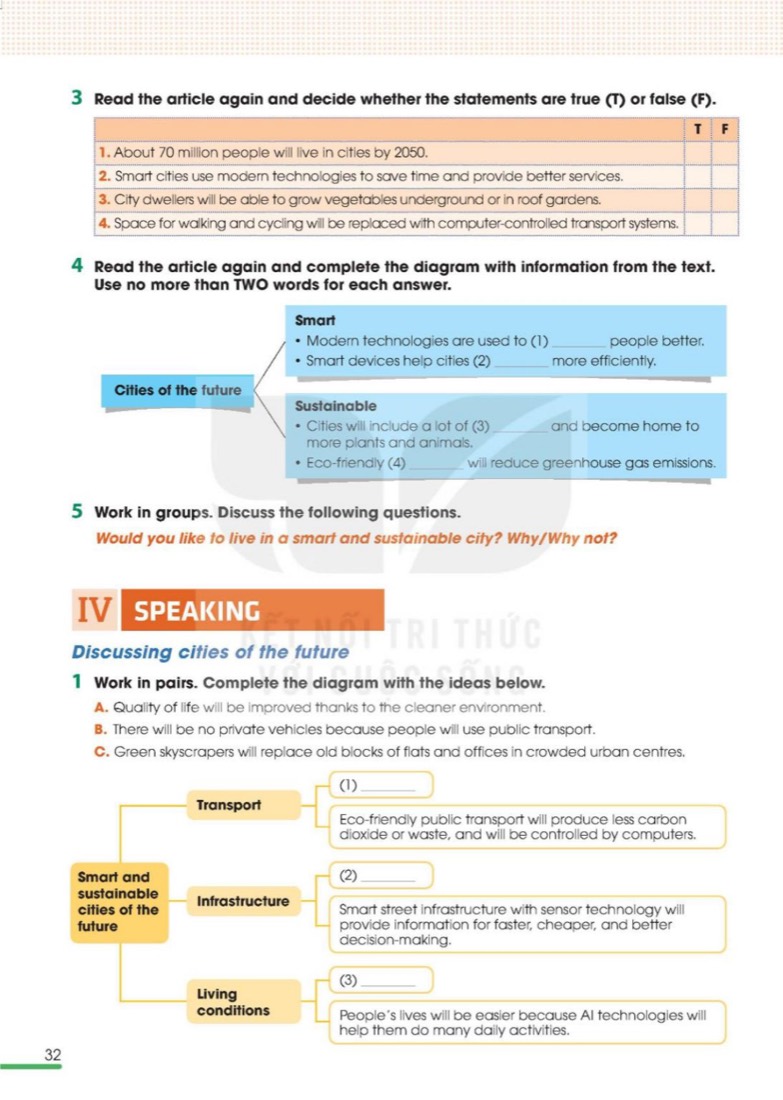
Activity 1: Work in pairs. Complete the diagram with the ideas below.
(Làm việc theo cặp. Hoàn thành sơ đồ với các ý tưởng bên dưới.)
- A. Quality of life will be improved thanks to the cleaner environment. (Chất lượng cuộc sống sẽ được cải thiện nhờ môi trường trong lành hơn.)
- B. There will be no private vehicles because people will use public transport. (Sẽ không còn phương tiện cá nhân vì mọi người sẽ sử dụng phương tiện giao thông công cộng.)
- C. Green skyscrapers will replace old blocks of flats and offices in crowded urban centres. (Các tòa nhà chọc trời xanh sẽ thay thế các khu chung cư và văn phòng cũ ở những trung tâm đô thị đông đúc.)
Cách làm & Phân tích logic:
- Mục Transport (Giao thông): Ý phụ bên dưới nói về "Eco-friendly public transport...". Do đó, vị trí (1) ghép với B (nói về private vehicles và public transport).
- Mục Infrastructure (Cơ sở hạ tầng): Liên quan đến các công trình xây dựng, đường xá. Vị trí (2) ghép với C (nói về green skyscrapers, blocks of flats and offices).
- Mục Living conditions (Điều kiện sống): Liên quan đến đời sống con người, môi trường sống. Vị trí (3) ghép với A (nói về quality of life và cleaner environment).
Đáp án:
- (1) - B
- (2) - C
- (3) - A
Activity 2: Match the questions with the answers to make a conversation. Then practise it in pairs.
(Nối câu hỏi với câu trả lời để tạo thành một đoạn hội thoại. Sau đó luyện tập theo cặp.)
Phân tích nối câu:
- Câu 1: What do you think transport will be like in the cities of the future? (Hỏi ý kiến chung về giao thông tương lai) → Ghép với c: Well, I think there will be no private vehicles in the cities.
- Câu 2: So, how will people travel in the city? (Hỏi cụ thể đi lại bằng cách nào nếu không có xe cá nhân) → Ghép với a: They will use public transport instead of their own vehicles.
- Câu 3: Really? Why do you think public transport will be popular with city dwellers? (Hỏi lý do tại sao giao thông công cộng lại phổ biến) → Ghép với b: Because technology will make public transport faster, more convenient, and more eco-friendly.
Đáp án: 1 - c | 2 - a | 3 - b
Activity 3: Work in pairs. Ask and answer questions about one of the features of future cities in 1. Use the model and the tips in 2 to help you.
(Làm việc theo cặp. Hỏi và trả lời về một trong các đặc điểm của thành phố tương lai ở bài 1. Sử dụng bài mẫu và các mẹo ở bài 2 để hỗ trợ.)
Gợi ý đoạn hội thoại mẫu 1: Về Cơ sở hạ tầng (Infrastructure)
Student A: What do you think infrastructure will be like in the cities of the future?
Student B: Well, I think green skyscrapers will replace old blocks of flats and offices in crowded urban centres.
Student A: How will smart street infrastructure help city dwellers?
Student B: Smart street infrastructure with sensor technology will provide information for faster, cheaper, and better decision-making.
Student A: Where will people live and work?
Student B: They will live and work in modern, eco-friendly green skyscrapers.
Gợi ý đoạn hội thoại mẫu 2: Về Điều kiện sống (Living conditions)
Student A: How will living conditions change in future cities?
Student B: I think people's quality of life will be improved thanks to the cleaner environment.
Student A: How will technology help people in their daily lives?
Student B: People's lives will be easier because AI technologies will help them do many daily activities.
Activity 4: Work in groups. Discuss what the cities of the future will be like and present your groups' ideas to the whole class.
(Làm việc theo nhóm. Thảo luận xem các thành phố tương lai sẽ như thế nào và trình bày ý tưởng của nhóm mình trước cả lớp.)
Gợi ý bài thuyết trình mẫu (tổng hợp 3 khía cạnh từ dữ liệu bài học):
"Hello everyone. Today, our group would like to present our ideas about smart and sustainable cities of the future."
"First, regarding transport, we believe there will be no private vehicles because people will choose public transport. Eco-friendly public transport will produce less carbon dioxide or waste and will be fully controlled by computers."
"Second, in terms of infrastructure, green skyscrapers will replace old blocks of flats and offices in crowded urban centres. In addition, smart street infrastructure with sensor technology will provide information for faster, cheaper, and better decision-making."
"Finally, concerning living conditions, the quality of life will be greatly improved thanks to a cleaner environment. People's lives will also be much easier because AI technologies will help them do many daily activities."
"Thank you for listening!"
🌟 Em đã học (Ghi nhớ kiến thức trọng tâm)
- Khám phá các ý tưởng đặc trưng của thành phố tương lai trên 3 phương diện: Giao thông (Transport), Cơ sở hạ tầng (Infrastructure) và Điều kiện sống (Living conditions).
- Ghi nhớ từ vựng và thuật ngữ then chốt: eco-friendly public transport, private vehicles, green skyscrapers, sensor technology, city dwellers, AI technologies.
- Nắm vững chiến thuật duy trì và phát triển cuộc hội thoại thông qua các câu hỏi bắt đầu bằng từ để hỏi (Wh-questions).
- Thực hành ghép nối câu hỏi – câu trả lời, thiết lập hội thoại theo cặp và thuyết trình nhóm về viễn cảnh đô thị tương lai.