Tiếng Anh lớp 11 · KNTT · Chương 8
Lý thuyết Tiếng Anh 11 Unit 6 · Looking Back & Project (Preserving our heritage)
Tổng hợp kiến thức trọng tâm của Unit 6: Preserving our heritage, bao gồm ngữ điệu câu và danh sách liệt kê, từ vựng bảo tồn di sản, mệnh đề to-infinitive và hướng dẫn thực hiện dự án bảo tồn di sản văn hóa, thiên nhiên.
1. Trang sách giáo khoa
2. Đọc hiểu mở rộng: Preserving Heritage Around the World (Culture)
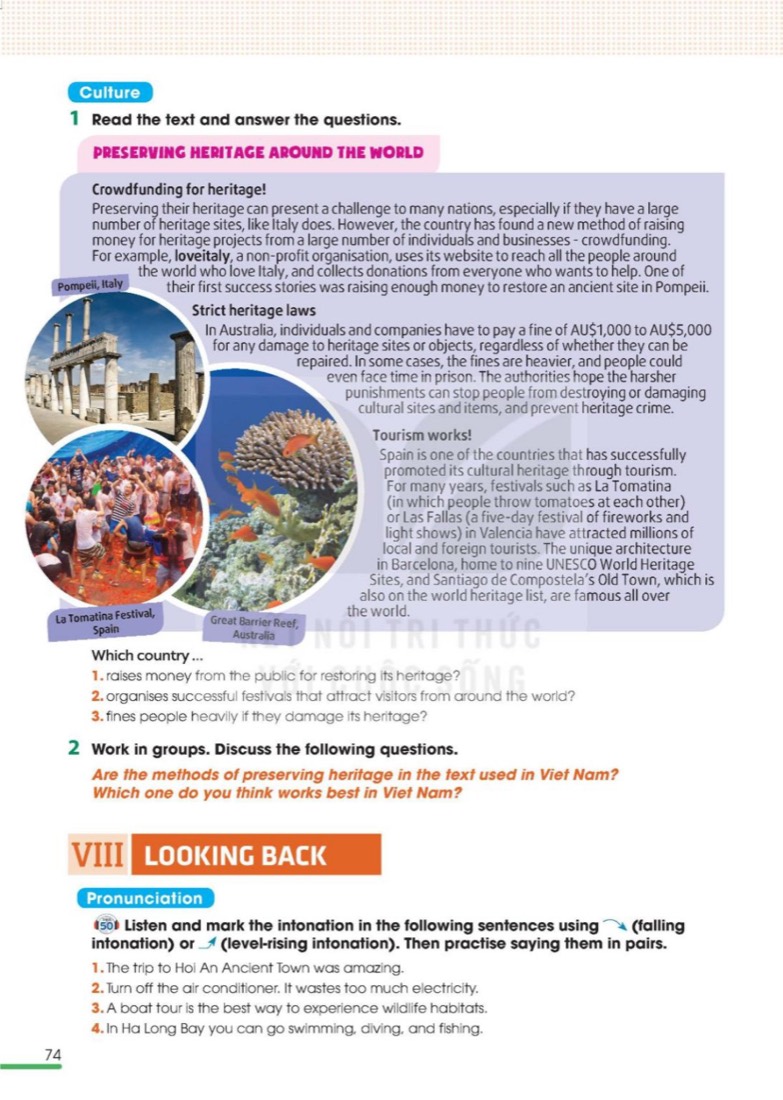
Phần Culture (trang 74) cung cấp các phương thức thực tế mà các quốc gia trên thế giới áp dụng để bảo tồn và phát huy giá trị di sản:
| Nguyên văn Tiếng Anh | Bản dịch Tiếng Việt |
|---|---|
| Crowdfunding for heritage! Preserving their heritage can present a challenge to many nations, especially if they have a large number of heritage sites, like Italy does. However, the country has found a new method of raising money for heritage projects from a large number of individuals and businesses - crowdfunding. For example, loveitaly, a non-profit organisation, uses its website to reach all the people around the world who love Italy, and collects donations from everyone who wants to help. One of their first success stories was raising enough money to restore an ancient site in Pompeii. |
Gây quỹ cộng đồng vì di sản! Bảo tồn di sản có thể là một thách thức đối với nhiều quốc gia, đặc biệt nếu họ có số lượng lớn các di sản như nước Ý. Tuy nhiên, quốc gia này đã tìm ra một phương pháp mới để gây quỹ cho các dự án di sản từ đông đảo cá nhân và doanh nghiệp - gây quỹ cộng đồng (crowdfunding). Ví dụ, loveitaly, một tổ chức phi lợi nhuận, sử dụng trang web của mình để tiếp cận mọi người trên khắp thế giới yêu mến nước Ý và thu thập các khoản quyên góp từ bất kỳ ai muốn giúp đỡ. Một trong những câu chuyện thành công đầu tiên của họ là quyên góp đủ tiền để phục dựng một di chỉ cổ ở Pompeii. |
| Strict heritage laws In Australia, individuals and companies have to pay a fine of AU5,000 for any damage to heritage sites or objects, regardless of whether they can be repaired. In some cases, the fines are heavier, and people could even face time in prison. The authorities hope the harsher punishments can stop people from destroying or damaging cultural sites and items, and prevent heritage crime. |
Luật di sản nghiêm ngặt Tại Úc, các cá nhân và công ty phải nộp phạt từ 1.000 đến 5.000 đô la Úc cho bất kỳ tổn hại nào đối với các di sản hoặc hiện vật, bất kể chúng có thể sửa chữa được hay không. Trong một số trường hợp, mức phạt còn nặng hơn và người vi phạm thậm chí có thể phải ngồi tù. Các cơ quan chức năng hy vọng những hình phạt nghiêm khắc hơn có thể ngăn chặn mọi người phá hủy hoặc làm hư hỏng các địa điểm, hiện vật văn hóa và ngăn ngừa tội phạm xâm hại di sản. |
| Tourism works! Spain is one of the countries that has successfully promoted its cultural heritage through tourism. For many years, festivals such as La Tomatina (in which people throw tomatoes at each other) or Las Fallas (a five-day festival of fireworks and light shows) in Valencia have attracted millions of local and foreign tourists. The unique architecture in Barcelona, home to nine UNESCO World Heritage Sites, and Santiago de Compostela's Old Town, which is also on the world heritage list, are famous all over the world. |
Du lịch mang lại hiệu quả! Tây Ban Nha là một trong những quốc gia đã quảng bá thành công di sản văn hóa của mình thông qua du lịch. Trong nhiều năm, các lễ hội như La Tomatina (nơi mọi người ném cà chua vào nhau) hay Las Fallas (lễ hội pháo hoa và trình diễn ánh sáng kéo dài năm ngày) ở Valencia đã thu hút hàng triệu du khách trong nước và quốc tế. Kiến trúc độc đáo ở Barcelona, nơi có 9 Di sản Thế giới được UNESCO công nhận, và Khu phố cổ Santiago de Compostela, nơi cũng nằm trong danh sách di sản thế giới, đều nổi tiếng khắp toàn cầu. |
3. Từ vựng trọng tâm (Vocabulary Review)
Dưới đây là các từ vựng then chốt xuất hiện trong phần bài tập ôn tập Looking Back và bài đọc mở rộng Culture:
| Từ vựng | Phiên âm IPA | Từ loại | Nghĩa tiếng Việt | Ví dụ trong bài học |
|---|---|---|---|---|
| well preserved | /ˌwel prɪˈzɜːvd/ | adj | được bảo tồn tốt, giữ gìn tốt | Many ancient houses in the city are not well preserved because of changes over time and bad weather. |
| historical | /hɪˈstɒrɪkl/ | adj | thuộc về lịch sử, liên quan đến lịch sử | His historical novels are based on events that happened in the early 19th century. |
| historic | /hɪˈstɒrɪk/ | adj | mang tính bước ngoặt, có ý nghĩa lịch sử trọng đại | The signing of the treaty was a historic moment. |
| folk music | /ˈfəʊk mjuːzɪk/ | n | nhạc dân gian, âm nhạc truyền thống | Older generations worry that folk music and dances will die out because young people only listen to pop music. |
| promote | /prəˈməʊt/ | v | quảng bá, xúc tiến | The heritage site is promoted as a tourist destination on social media. |
| protect | /prəˈtekt/ | v | bảo vệ, gìn giữ khỏi nguy hại | Harsher punishments can protect cultural sites from being destroyed. |
| crowdfunding | /ˈkraʊdfʌndɪŋ/ | n | hình thức gây quỹ cộng đồng | The country found a new method of raising money for heritage projects: crowdfunding. |
| restore | /rɪˈstɔː(r)/ | v | trùng tu, phục hồi | They raised enough money to restore an ancient site in Pompeii. |
| heritage crime | /ˈherɪtɪdʒ kraɪm/ | n | tội phạm xâm hại di sản | The authorities hope the harsher punishments can prevent heritage crime. |
4. Kiến thức Ngữ âm & Ngữ pháp trọng tâm
A. Ngữ âm: Ngữ điệu câu trần thuật, mệnh lệnh và danh sách liệt kê (Intonation)
- Ngữ điệu xuống (Falling intonation ⤵): Thường được sử dụng ở cuối câu trần thuật (statements) và câu mệnh lệnh (commands) để thể hiện sự dứt khoát, hoàn chỉnh của ý niệm.
Ví dụ: Turn off the air conditioner. ⤵ / The trip to Hoi An Ancient Town was amazing. ⤵ - Ngữ điệu lên giọng ngang (Level-rising intonation ⤴): Được dùng cho từng thành phần trong danh sách liệt kê (lists) để biểu thị rằng danh sách vẫn còn tiếp diễn. Riêng thành phần cuối cùng của danh sách sẽ dùng ngữ điệu xuống (⤵) để báo hiệu danh sách đã kết thúc.
Ví dụ: In Ha Long Bay you can go swimming ⤴, diving ⤴, and fishing ⤵.
B. Ngữ pháp: Mệnh đề nguyên mẫu có 'to' (to-infinitive clauses)
Mệnh đề nguyên mẫu có to được dùng trong hai trường hợp phổ biến của Unit 6:
| Mục đích sử dụng | Quy tắc & Cấu trúc | Ví dụ minh họa |
|---|---|---|
| 1. Diễn đạt mục đích (Clauses of purpose) | Thay thế cho mệnh đề chỉ lý do/mục đích bắt đầu bằng because + S + wanted to + V hoặc in order to / so that. S + V + (O) + to-V... |
Mai went to Soc Son because she wanted to attend the Giong Festival. → Mai went to Soc Son to attend the Giong Festival. |
| 2. Rút gọn mệnh đề quan hệ (Reduced relative clauses) | Dùng sau các danh từ có đi kèm từ thứ tự (the first, the second, the last...), từ duy nhất (the only), hoặc tính từ so sánh nhất (the most famous, the best...). the first / the most... + N + to-V |
The first place that you can visit on the trip is Hue Imperial Citadel. → The first place to visit on the trip is Hue Imperial Citadel. |
Lưu ý quan trọng: Khi rút gọn mệnh đề quan hệ sang to-V, cần lược bỏ đại từ quan hệ (who, that, which) và trợ động từ tình thái (can, could).
5. Hướng dẫn làm bài tập SGK
I. CULTURE (Trang 74)
Hoạt động 1: Read the text and answer the questions. (Đọc văn bản và trả lời câu hỏi: Quốc gia nào...)
- 1. Which country raises money from the public for restoring its heritage?
Đáp án: Italy
Giải thích: Dẫn chứng đoạn 1: "However, the country has found a new method of raising money for heritage projects from a large number of individuals and businesses - crowdfunding... to restore an ancient site in Pompeii." - 2. Which country organises successful festivals that attract visitors from around the world?
Đáp án: Spain
Giải thích: Dẫn chứng đoạn 3: "Spain is one of the countries that has successfully promoted its cultural heritage through tourism. For many years, festivals such as La Tomatina... or Las Fallas... have attracted millions of local and foreign tourists." - 3. Which country fines people heavily if they damage its heritage?
Đáp án: Australia
Giải thích: Dẫn chứng đoạn 2: "In Australia, individuals and companies have to pay a fine of AU5,000 for any damage to heritage sites or objects... In some cases, the fines are heavier, and people could even face time in prison."
Hoạt động 2: Work in groups. Discuss the following questions. (Thảo luận: Các phương pháp bảo tồn di sản trong bài có được dùng ở Việt Nam không? Phương pháp nào bạn nghĩ mang lại hiệu quả tốt nhất ở Việt Nam?)
- Gợi ý trả lời:
- Are the methods used in Viet Nam? Yes, promoting heritage through tourism is widely used in Viet Nam (e.g. promoting Hue, Hoi An, Ha Long Bay). Strict regulations and fines are also applied to protect historical relics. Crowdfunding has started to appear for some local conservation projects.
- Which one works best? Promoting cultural heritage through tourism (like Spain does) works very well in Viet Nam because it generates income for local communities and raises public awareness at the same time.
II. LOOKING BACK (Trang 74 - 75)
Pronunciation: Listen and mark the intonation using ⤵ (falling intonation) or ⤴ (level-rising intonation).
- 1. The trip to Hoi An Ancient Town was amazing. ⤵
Giải thích: Đây là câu trần thuật khẳng định nên sử dụng ngữ điệu xuống ở cuối câu. - 2. Turn off the air conditioner. ⤵ It wastes too much electricity. ⤵
Giải thích: Vế đầu là câu mệnh lệnh (commands), vế sau là câu trần thuật (statements); cả hai đều hạ giọng ở cuối câu. - 3. A boat tour is the best way to experience wildlife habitats. ⤵
Giải thích: Câu trần thuật đơn thông báo thông tin, xuống giọng ở cuối câu. - 4. In Ha Long Bay you can go swimming ⤴, diving ⤴, and fishing. ⤵
Giải thích: Đây là một danh sách liệt kê ba hoạt động. Hai mục đầu lên giọng ngang (⤴) để báo hiệu chưa hết câu, mục cuối cùng hạ giọng (⤵) kết thúc câu.
Vocabulary: Choose the correct word to complete each sentence.
- 1. Many ancient houses in the city are not well preserved because of changes over time and bad weather.
Giải thích: Cần tính từ chỉ trạng thái nguyên vẹn của ngôi nhà cổ chịu ảnh hưởng bởi thời gian và thời tiết. Chọn well preserved (được bảo tồn tốt). well promoted mang nghĩa "được quảng bá tốt" là không hợp ngữ cảnh. - 2. His historical novels are based on events that happened in the early 19th century.
Giải thích: historical novels là tiểu thuyết lịch sử (tiểu thuyết viết về đề tài lịch sử trong quá khứ). historic chỉ những gì có tầm quan trọng lịch sử trọng đại (ví dụ: historic event/building). - 3. Older generations worry that folk music and dances will die out because young people only listen to pop music.
Giải thích: Cụm từ cố định folk music (âm nhạc dân gian/truyền thống) đối lập với pop music (nhạc trẻ đương đại). - 4. The heritage site is promoted as a tourist destination on social media.
Giải thích: Quảng bá trên mạng xã hội như một điểm đến du lịch dùng động từ promoted (được quảng bá).
Grammar: Rewrite the sentences using to-infinitive clauses.
- 1. Mai went to Soc Son because she wanted to attend the Giong Festival.
→ Mai went to Soc Son to attend the Giong Festival.
Giải thích: Rút gọn mệnh đề chỉ lý do/mục đích because she wanted to attend thành to attend. - 2. The first place that you can visit on the trip is Hue Imperial Citadel.
→ The first place to visit on the trip is Hue Imperial Citadel.
Giải thích: Rút gọn mệnh đề quan hệ that you can visit sau cụm từ có số thứ tự The first place thành to visit. - 3. Our music teacher gave lessons in xoan singing because she wanted to help us appreciate our cultural heritage.
→ Our music teacher gave lessons in xoan singing to help us appreciate our cultural heritage.
Giải thích: Rút gọn mệnh đề chỉ mục đích because she wanted to help thành to help. - 4. The most famous site that you can see is the old bridge across the river.
→ The most famous site to see is the old bridge across the river.
Giải thích: Rút gọn mệnh đề quan hệ that you can see sau cấu trúc so sánh nhất The most famous site thành to see.
6. Hướng dẫn thực hiện dự án (Project: How can we preserve our heritage?)
Nhiệm vụ của dự án:
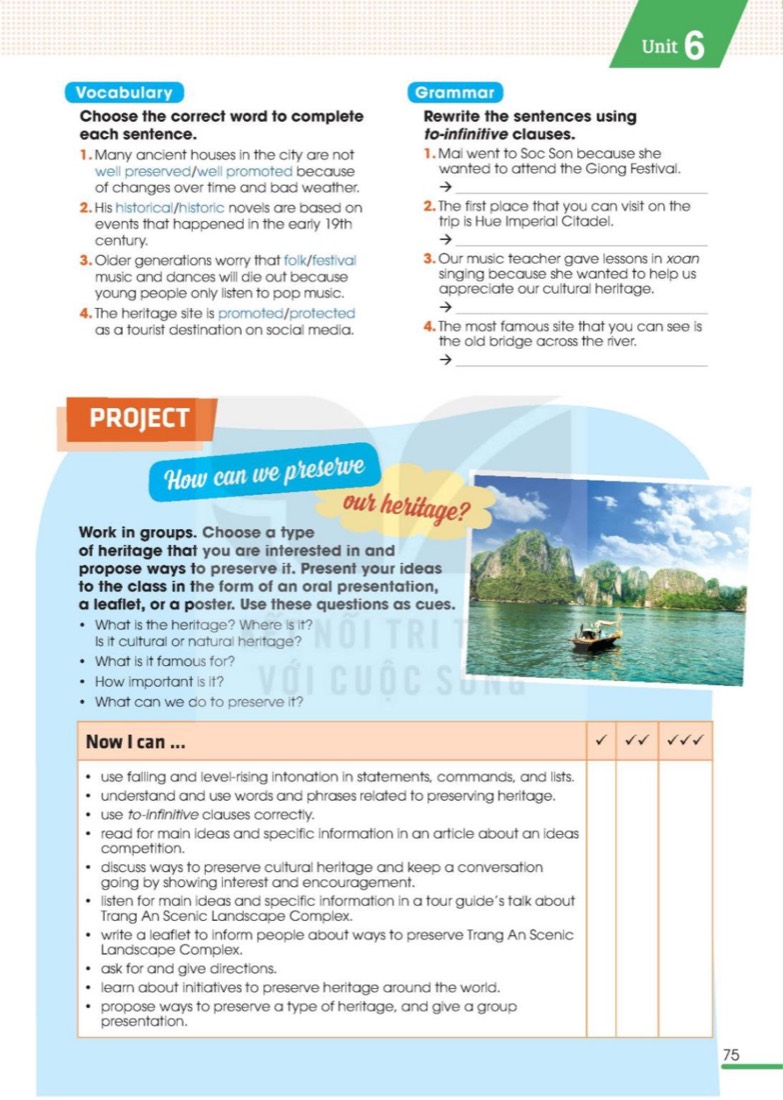
Làm việc theo nhóm: Chọn một loại hình di sản mà nhóm quan tâm và đề xuất các giải pháp bảo tồn. Trình bày ý tưởng trước lớp dưới dạng bài thuyết trình nói (oral presentation), tờ rơi (leaflet) hoặc áp phích (poster) dựa vào các câu hỏi gợi ý trong SGK:
- What is the heritage? Where is it? Is it cultural or natural heritage? (Di sản đó là gì? Ở đâu? Đó là di sản văn hóa hay thiên nhiên?)
- What is it famous for? (Nó nổi tiếng vì điều gì?)
- How important is it? (Nó quan trọng như thế nào?)
- What can we do to preserve it? (Chúng ta có thể làm gì để bảo tồn nó?)
Gợi ý dàn bài thuyết trình mẫu (Chủ đề: Trang An Scenic Landscape Complex):
| Nội dung Tiếng Anh | Bản dịch Tiếng Việt |
|---|---|
| Good morning everyone. Today our group would like to talk about Trang An Scenic Landscape Complex in Ninh Binh Province. It is a mixed cultural and natural heritage site recognized by UNESCO. | Chào buổi sáng mọi người. Hôm nay nhóm chúng mình muốn nói về Quần thể danh thắng Tràng An tại tỉnh Ninh Bình. Đây là một di sản hỗn hợp cả văn hóa lẫn thiên nhiên được UNESCO công nhận. |
| Trang An is famous for its breathtaking limestone karst peaks, mysterious caves, and ancient temples. It is extremely important because it preserves rare ecological habitats and evidence of prehistoric human settlement. | Tràng An nổi tiếng với những đỉnh núi đá vôi ngoạn mục, những hang động kỳ bí và các ngôi đền cổ kính. Nơi đây vô cùng quan trọng vì lưu giữ các sinh cảnh sinh thái quý hiếm và bằng chứng về nơi cư trú của người tiền sử. |
| To preserve Trang An, we propose three practical solutions: 1. Encourage eco-friendly tourism and fine tourists who litter into the river or damage natural caves. 2. Educate local people and students about preserving cultural values. 3. Use social media to raise awareness and promote responsible travel. |
Để bảo tồn Tràng An, nhóm chúng mình đề xuất 3 giải pháp thiết thực: 1. Khuyến khích du lịch thân thiện với môi trường và xử phạt du khách vứt rác xuống sông hoặc làm hư hại hang động. 2. Giáo dục người dân địa phương và học sinh về việc gìn giữ các giá trị văn hóa. 3. Sử dụng mạng xã hội để nâng cao nhận thức và quảng bá du lịch có trách nhiệm. |
🌟 Em đã học (Ghi nhớ kiến thức trọng tâm)
- Nắm vững quy tắc ngữ điệu xuống (falling intonation ⤵) cho câu trần thuật, mệnh lệnh và ngữ điệu lên ngang (level-rising ⤴) trong danh sách liệt kê.
- Củng cố và phân biệt các từ vựng chủ đề di sản: well preserved, historical vs historic, folk music, promote, protect.
- Luyện tập biến đổi câu sử dụng mệnh đề nguyên mẫu có 'to' (to-infinitive clauses) để chỉ mục đích và rút gọn mệnh đề quan hệ sau số thứ tự/so sánh nhất.
- Tìm hiểu các sáng kiến bảo tồn di sản trên thế giới (Italy, Australia, Spain) và hoàn thành dự án 'How can we preserve our heritage?'.