Tiếng Anh lớp 12 · KNTT · Chương 11
Lý thuyết Tiếng Anh 12 Review 3 (Artificial Intelligence in the mass media)
Tổng hợp toàn bộ kiến thức trọng tâm về Ngữ âm, Từ vựng, Ngữ pháp của các Unit 6, 7, 8 và hướng dẫn giải chi tiết các bài tập trong bài Review 3 (SGK Tiếng Anh 12 Global Success).
1. Trang sách giáo khoa
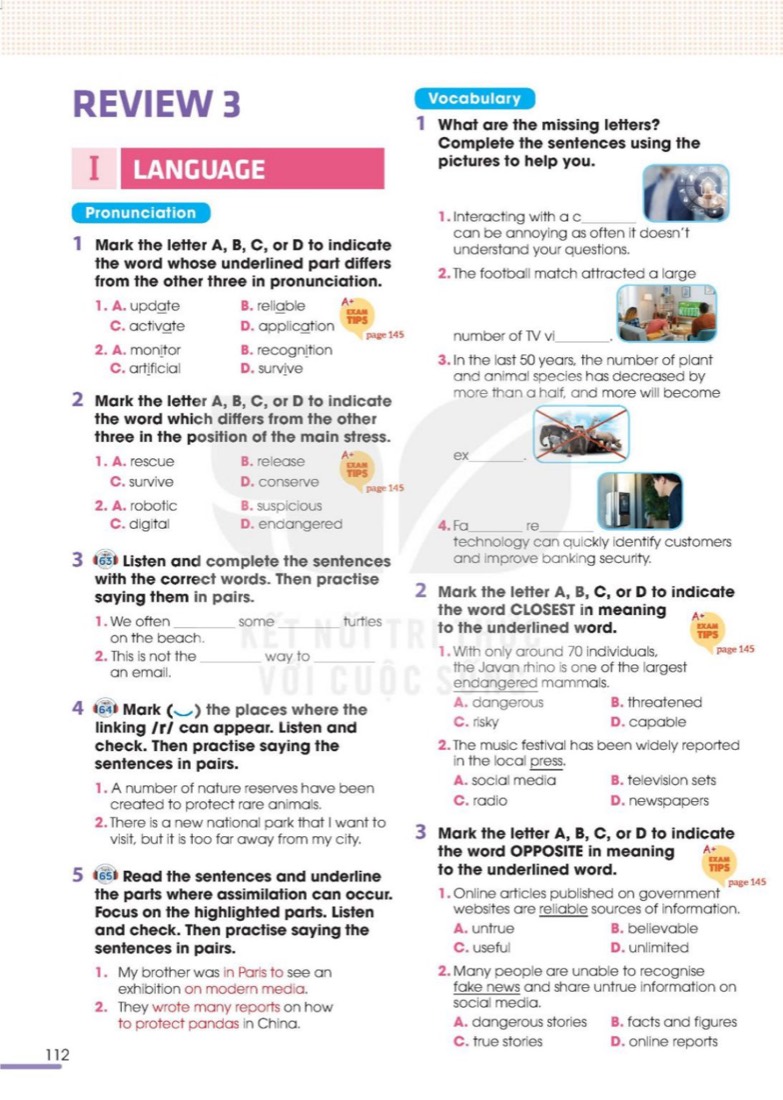
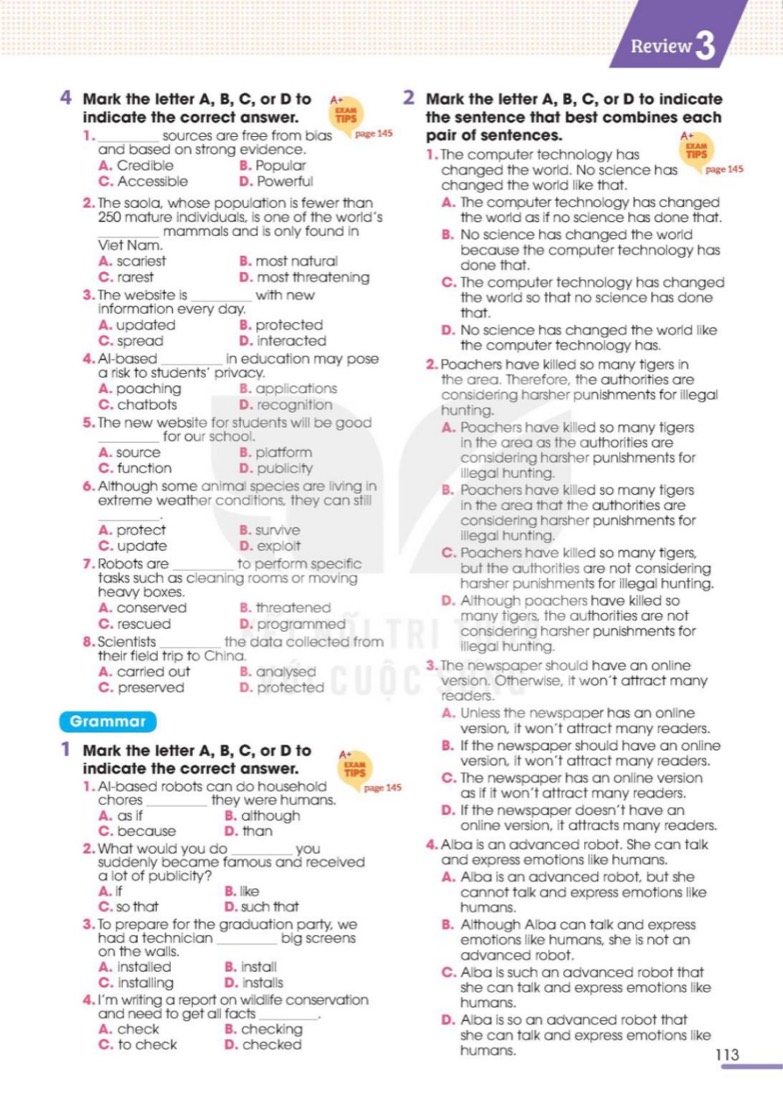
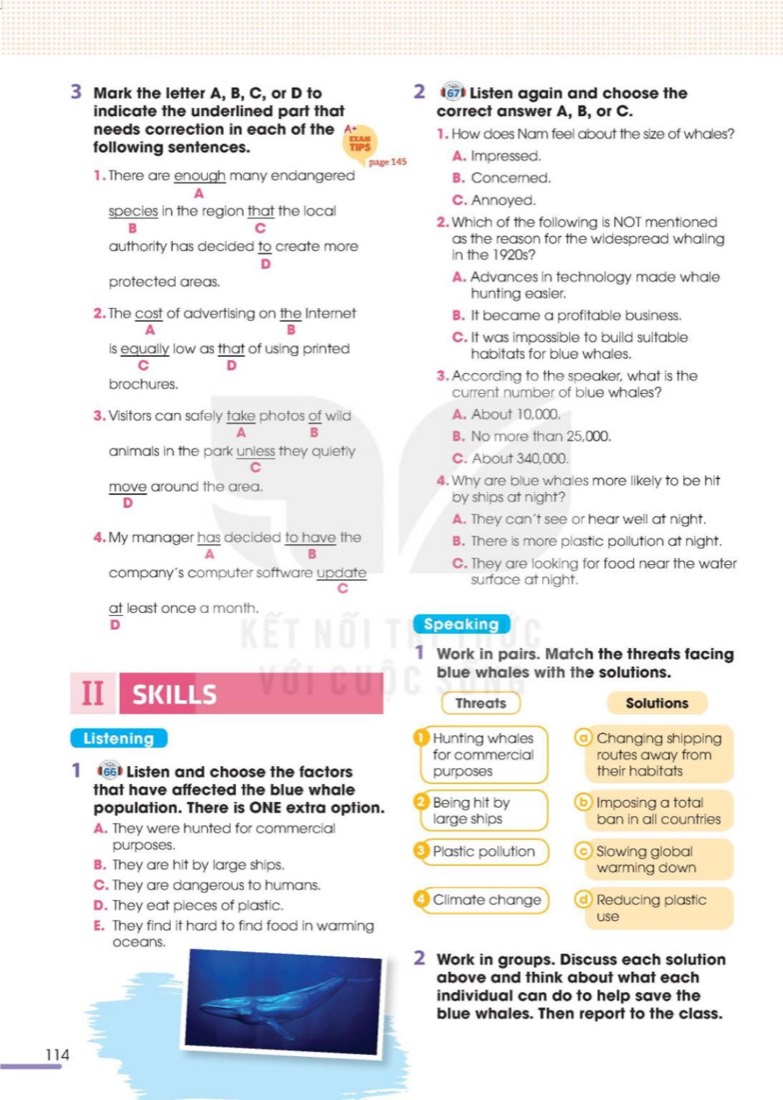
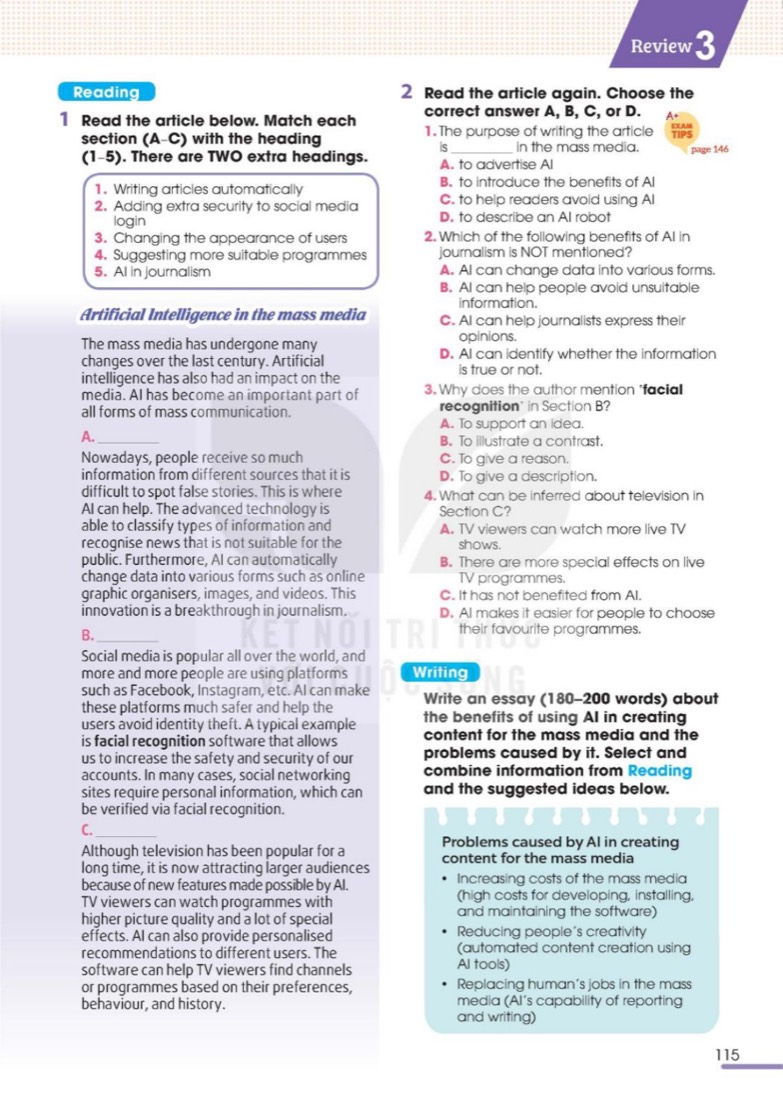
2. Bảng từ vựng trọng tâm (Vocabulary Review 3)
Dưới đây là các từ vựng và thuật ngữ xuất hiện xuyên suốt các bài tập và bài đọc của phần Review 3, tổng hợp từ các Unit 6, 7 và 8:
| Từ vựng | Phiên âm IPA | Từ loại | Nghĩa tiếng Việt | Ví dụ trong bài |
|---|---|---|---|---|
| endangered | /ɪnˈdeɪndʒəd/ | adj | có nguy cơ tuyệt chủng, bị đe dọa | The Javan rhino is one of the largest endangered mammals. |
| threatened | /ˈθretnd/ | adj | bị đe dọa | With only around 70 individuals, the rhino is heavily threatened. |
| local press | /ˈləʊkl pres/ | n. phr | báo chí địa phương | The music festival has been widely reported in the local press. |
| reliable | /rɪˈlaɪəbl/ | adj | đáng tin cậy | Online articles on government websites are reliable sources. |
| fake news | /ˌfeɪk ˈnjuːz/ | n. phr | tin giả, tin sai sự thật | Many people are unable to recognise fake news on social media. |
| credible | /ˈkredəbl/ | adj | đáng tin, xác thực | Credible sources are free from bias and based on strong evidence. |
| rare | /reə(r)/ | adj | hiếm | The saola is one of the world's rarest mammals. |
| update | /ʌpˈdeɪt/ | v | cập nhật | The website is updated with new information every day. |
| application | /ˌæplɪˈkeɪʃn/ | n | ứng dụng | AI-based applications in education may pose a risk to privacy. |
| publicity | /pʌbˈlɪsəti/ | n | sự chú ý của công chúng, sự quảng bá | The new website for students will be good publicity for our school. |
| survive | /səˈvaɪv/ | v | sống sót, sinh tồn | Although living in extreme conditions, they can still survive. |
| programme | /ˈprəʊɡræm/ | v | lập trình | Robots are programmed to perform specific tasks. |
| analyse | /ˈænəlaɪz/ | v | phân tích | Scientists analysed the data collected from their field trip. |
| chatbot | /ˈtʃætbɒt/ | n | hộp thoại tự động / rô-bốt trò chuyện | Interacting with a chatbot can sometimes be annoying. |
| facial recognition | /ˈfeɪʃl rekəɡˌnɪʃn/ | n. phr | nhận diện khuôn mặt | Facial recognition technology can quickly identify customers. |
| extinct | /ɪkˈstɪŋkt/ | adj | tuyệt chủng | More animal species will become extinct in the future. |
| viewer | /ˈvjuːə(r)/ | n | người xem truyền hình | The football match attracted a large number of TV viewers. |
| poacher | /ˈpəʊtʃə(r)/ | n | kẻ săn trộm | Poachers have killed so many tigers in the area. |
| identity theft | /aɪˈdentəti θeft/ | n. phr | đánh cắp danh tính | AI helps users avoid identity theft on social media. |
| breakthrough | /ˈbreɪkθruː/ | n | bước đột phá | This innovation is a breakthrough in journalism. |
3. Hệ thống Ngữ âm & Ngữ pháp ôn tập
A. Ngữ âm (Pronunciation)
- 1. Hiện tượng nối âm /r/ (Linking /r/): Trong tiếng Anh - Anh (non-rhotic accent), âm /r/ ở cuối một từ vốn là âm câm khi đứng độc lập hoặc đứng trước một phụ âm (ví dụ: rare /reə/, far /fɑː/). Tuy nhiên, khi từ tiếp theo bắt đầu bằng một nguyên âm, âm /r/ sẽ được phát âm rõ để nối liền mạch hai từ lại với nhau.
Ví dụ: rare‿animals (/reər‿ˈænɪməlz/), fa‿raway (/fɑːr‿əˈweɪ/), numbe‿rof (/ˈnʌmbər‿əv/). - 2. Hiện tượng đồng hóa âm (Assimilation): Khi nói ở tốc độ tự nhiên, âm kết thúc của từ đứng trước có xu hướng biến đổi để hòa hợp với âm đầu của từ đứng liền sau nhằm giúp việc phát âm dễ dàng hơn:
- Âm /n/ biến thành /m/ khi đứng trước các phụ âm môi /p, b, m/: in Paris đọc là /ɪm ˈpærɪs/; modern media đọc là /ˈmɒdəm ˈmiːdiə/.
- Âm /t/ biến thành /p/ khi đứng trước các phụ âm môi /p, b, m/: protect pandas đọc thành /prəˈtekp ˈpændəz/.
- Âm /n/ biến thành /ŋ/ khi đứng trước âm vòm mềm /k, ɡ/ hoặc chuyển hóa trước âm tắc sát: in China (/ɪŋ ˈtʃaɪnə/).
- 3. Từ đồng âm (Homophones): Là các từ có cách viết và ý nghĩa hoàn toàn khác nhau nhưng lại có cách phát âm giống hệt nhau. Trong bài học, chúng bắt gặp hai cặp từ kinh điển: see /siː/ (nhìn) – sea /siː/ (biển) và right /raɪt/ (đúng) – write /raɪt/ (viết).
B. Ngữ pháp trọng tâm (Grammar Focus)
- 1. Cấu trúc sai khiến / nhờ vả (Causative Verbs with Have & Get):
- Dạng chủ động (Active):
S + have + O (người) + V-nguyên thể (bare infinitive)
Ví dụ: We had a technician install big screens on the walls.S + get + O (người) + to-V - Dạng bị động (Passive): Nhờ ai làm việc gì hoặc có cái gì được làm bởi ai.
S + have / get + O (vật) + V-ed/P2 (past participle)
Ví dụ: I need to get all facts checked.
The manager decided to have the software updated.
- Dạng chủ động (Active):
- 2. Mệnh đề so sánh giả định với "as if / as though":
Dùng để diễn tả sự việc, tình huống không có thật ở hiện tại (lùi thì về Quá khứ đơn, động từ to be thường dùng were cho tất cả các ngôi):
S + V (hiện tại) + as if / as though + S + V-ed / wereVí dụ: AI-based robots can do household chores as if they were humans. (Rô-bốt AI làm việc nhà như thể chúng là con người).
- 3. Cấu trúc chỉ kết quả với "So... that" và "Such... that":
S + V + so + many/few + N (đếm được số nhiều) + that + S + V
Ví dụ: Poachers have killed so many tigers in the area that the authorities are considering harsher punishments.S + be + such + (a/an) + Adj + N + that + S + V
Ví dụ: Alba is such an advanced robot that she can talk and express emotions like humans.
- 4. Câu điều kiện loại 2 và liên từ "Unless":
- Câu điều kiện loại 2 (giả định trái với hiện tại):
What would you do if you suddenly became famous...? - Unless = If... not (Trừ khi / Nếu... không):
Unless the newspaper has an online version, it won't attract many readers.(= If the newspaper doesn't have an online version, it won't attract many readers.)
- Câu điều kiện loại 2 (giả định trái với hiện tại):
4. Bài đọc hiểu: Artificial Intelligence in the mass media
Dưới đây là nguyên văn bài đọc trong phần Reading (trang 115) kèm bản dịch tiếng Việt đối chiếu:
| Nguyên văn tiếng Anh (SGK) | Bản dịch tiếng Việt |
|---|---|
| Artificial Intelligence in the mass media The mass media has undergone many changes over the last century. Artificial intelligence has also had an impact on the media. AI has become an important part of all forms of mass communication. |
Trí tuệ nhân tạo trong truyền thông đại chúng Phương tiện truyền thông đại chúng đã trải qua nhiều thay đổi trong thế kỷ qua. Trí tuệ nhân tạo cũng đã tác động mạnh mẽ đến truyền thông. AI đã trở thành một phần quan trọng trong mọi hình thức truyền thông đại chúng. |
| Section A Nowadays, people receive so much information from different sources that it is difficult to spot false stories. This is where AI can help. The advanced technology is able to classify types of information and recognise news that is not suitable for the public. Furthermore, AI can automatically change data into various forms such as online graphic organisers, images, and videos. This innovation is a breakthrough in journalism. |
Đoạn A Ngày nay, con người tiếp nhận quá nhiều thông tin từ nhiều nguồn khác nhau đến mức rất khó phát hiện ra các câu chuyện sai sự thật. Đây chính là lúc AI có thể hỗ trợ. Công nghệ tiên tiến này có khả năng phân loại các loại thông tin và nhận diện những tin tức không phù hợp với công chúng. Hơn nữa, AI có thể tự động chuyển đổi dữ liệu thành nhiều dạng khác nhau như sơ đồ tổ chức đồ họa trực tuyến, hình ảnh và video. Sự đổi mới này là một bước đột phá trong ngành báo chí. |
| Section B Social media is popular all over the world, and more and more people are using platforms such as Facebook, Instagram, etc. AI can make these platforms much safer and help the users avoid identity theft. A typical example is facial recognition software that allows us to increase the safety and security of our accounts. In many cases, social networking sites require personal information, which can be verified via facial recognition. |
Đoạn B Mạng xã hội đang rất phổ biến trên toàn thế giới, và ngày càng có nhiều người sử dụng các nền tảng như Facebook, Instagram, v.v. AI có thể giúp các nền tảng này trở nên an toàn hơn nhiều và hỗ trợ người dùng tránh bị đánh cắp danh tính. Một ví dụ điển hình là phần mềm nhận diện khuôn mặt cho phép chúng ta tăng cường tính an toàn và bảo mật cho tài khoản của mình. Trong nhiều trường hợp, các trang mạng xã hội yêu cầu thông tin cá nhân, vốn có thể được xác minh thông qua nhận diện khuôn mặt. |
| Section C Although television has been popular for a long time, it is now attracting larger audiences because of new features made possible by AI. TV viewers can watch programmes with higher picture quality and a lot of special effects. AI can also provide personalised recommendations to different users. The software can help TV viewers find channels or programmes based on their preferences, behaviour, and history. |
Đoạn C Dù truyền hình đã phổ biến từ lâu, hiện nay nó đang thu hút lượng khán giả đông đảo hơn nhờ những tính năng mới do AI mang lại. Khán giả xem truyền hình có thể thưởng thức các chương trình với chất lượng hình ảnh cao hơn cùng rất nhiều kỹ xảo đặc biệt. AI cũng có thể đưa ra các gợi ý mang tính cá nhân hóa cho từng người dùng khác nhau. Phần mềm này có thể hỗ trợ khán giả tìm kênh hoặc chương trình dựa trên sở thích, thói quen và lịch sử xem của họ. |
5. Hướng dẫn làm bài tập SGK - Phần I: LANGUAGE
Pronunciation
1. Mark the letter A, B, C, or D to indicate the word whose underlined part differs from the other three in pronunciation.
- Câu 1:
- A. update /ʌpˈdeɪt/ hoặc /ˈʌpdeɪt/ (âm /eɪ/)
- B. reliable /rɪˈlaɪəbl/ (âm /ə/)
- C. activate /ˈæktɪveɪt/ (âm /æ/)
- D. application /ˌæplɪˈkeɪʃn/ (âm /æ/)
- Câu 2:
- A. monitor /ˈmɒnɪtə(r)/ (chữ 'i' phát âm là /ɪ/)
- B. recognition /ˌrekəɡˈnɪʃn/ (chữ 'i' phát âm là /ɪ/)
- C. artificial /ˌɑːtɪˈfɪʃl/ (chữ 'i' phát âm là /ɪ/)
- D. survive /səˈvaɪv/ (chữ 'i' phát âm là /aɪ/)
2. Mark the letter A, B, C, or D to indicate the word which differs from the other three in the position of the main stress.
- Câu 1:
- A. rescue /ˈreskjuː/ (trọng âm rơi vào âm tiết thứ 1)
- B. release /rɪˈliːs/ (trọng âm rơi vào âm tiết thứ 2)
- C. survive /səˈvaɪv/ (trọng âm rơi vào âm tiết thứ 2)
- D. conserve /kənˈsɜːv/ (trọng âm rơi vào âm tiết thứ 2)
- Câu 2:
- A. robotic /rəʊˈbɒtɪk/ (hậu tố -ic làm trọng âm rơi vào âm tiết liền trước: âm tiết thứ 2)
- B. suspicious /səˈspɪʃəs/ (hậu tố -ious làm trọng âm rơi vào âm tiết liền trước: âm tiết thứ 2)
- C. digital /ˈdɪdʒɪtl/ (trọng âm rơi vào âm tiết thứ 1)
- D. endangered /ɪnˈdeɪndʒəd/ (trọng âm rơi vào âm tiết thứ 2)
3. [Audio 63] Listen and complete the sentences with the correct words. Then practise saying them in pairs.
Phân tích: Dạng bài ôn luyện từ đồng âm (homophones).
- 1. We often see some sea turtles on the beach. (Chúng tôi thường nhìn thấy một số loài rùa biển trên bãi biển. Cặp từ: see - sea đều có phiên âm là /siː/).
- 2. This is not the right way to write an email. (Đây không phải là cách đúng đắn để viết một email. Cặp từ: right - write đều có phiên âm là /raɪt/).
4. [Audio 64] Mark (‿) the places where the linking /r/ can appear. Listen and check.
Quy tắc: Âm /r/ ở cuối từ sẽ nối với nguyên âm mở đầu của từ đứng kế tiếp.
- 1. A number‿of nature reserves have been created to protect rare‿animals.
- 2. There is a new national park that I want to visit, but it is too far‿away from my city.
5. [Audio 65] Read the sentences and underline the parts where assimilation can occur. Focus on the highlighted parts.
- 1. My brother was in Paris (/n/ + /p/ → /ɪm ˈpærɪs/) to see an exhibition on modern media (/n/ + /m/ → /ˈmɒdəm ˈmiːdiə/).
- 2. They wrote many reports on how to protect pandas (/t/ + /p/ → /prəˈtekp ˈpændəz/) in China (/n/ + /tʃ/ → /ɪŋ ˈtʃaɪnə/).
Vocabulary
1. Complete the sentences using the pictures to help you:
- 1. Interacting with a chatbot can be annoying as often it doesn't understand your questions. (Trò chuyện với rô-bốt trò chuyện tự động...)
- 2. The football match attracted a large number of TV viewers. (Trận bóng đá đã thu hút một lượng lớn khán giả truyền hình.)
- 3. In the last 50 years, the number of plant and animal species has decreased by more than a half, and more will become extinct. (...sẽ trở nên tuyệt chủng.)
- 4. Facial recognition technology can quickly identify customers and improve banking security. (Công nghệ nhận diện khuôn mặt...)
2. Mark the letter A, B, C, or D to indicate the word CLOSEST in meaning:
- 1. With only around 70 individuals, the Javan rhino is one of the largest endangered mammals.
Đáp án: B. threatened (endangered = threatened: có nguy cơ tuyệt chủng, bị đe dọa). - 2. The music festival has been widely reported in the local press.
Đáp án: D. newspapers (the press = newspapers: báo chí).
3. Mark the letter A, B, C, or D to indicate the word OPPOSITE in meaning:
- 1. Online articles published on government websites are reliable sources of information.
Đáp án: A. untrue (reliable: đáng tin cậy ≠ untrue: không đúng, sai sự thật). - 2. Many people are unable to recognise fake news and share untrue information on social media.
Đáp án: C. true stories (fake news: tin giả ≠ true stories: câu chuyện có thật).
4. Mark the letter A, B, C, or D to indicate the correct answer:
- 1. A. Credible sources are free from bias and based on strong evidence. (Các nguồn tin đáng tin cậy/xác thực không có thiên kiến và dựa trên bằng chứng vững chắc.)
- 2. The saola, whose population is fewer than 250 mature individuals, is one of the world's C. rarest mammals and is only found in Viet Nam. (Sao la là một trong những loài thú quý hiếm nhất thế giới...)
- 3. The website is A. updated with new information every day. (Trang web được cập nhật thông tin mới mỗi ngày.)
- 4. AI-based B. applications in education may pose a risk to students' privacy. (Các ứng dụng dựa trên nền tảng AI...)
- 5. The new website for students will be good D. publicity for our school. (Trang web mới sẽ là sự quảng bá tốt cho trường chúng ta.)
- 6. Although some animal species are living in extreme weather conditions, they can still B. survive. (...chúng vẫn có thể sinh tồn/sống sót.)
- 7. Robots are D. programmed to perform specific tasks such as cleaning rooms or moving heavy boxes. (Rô-bốt được lập trình để thực hiện...)
- 8. Scientists B. analysed the data collected from their field trip to China. (Các nhà khoa học đã phân tích số liệu thu thập được...)
Grammar
1. Mark the letter A, B, C, or D to indicate the correct answer:
- 1. AI-based robots can do household chores A. as if they were humans. (Cấu trúc as if + giả định không có thật ở hiện tại: như thể là).
- 2. What would you do A. if you suddenly became famous and received a lot of publicity? (Cấu trúc câu điều kiện loại 2: If + S + V-quá khứ đơn, S + would + V-nguyên thể).
- 3. To prepare for the graduation party, we had a technician B. install big screens on the walls. (Cấu trúc sai khiến chủ động: had + sb + V-nguyên thể).
- 4. I'm writing a report on wildlife conservation and need to get all facts D. checked. (Cấu trúc sai khiến bị động: get + sth + V-ed/P2).
2. Mark the letter A, B, C, or D to indicate the sentence that best combines each pair of sentences:
- 1. The computer technology has changed the world. No science has changed the world like that.
Đáp án: D. No science has changed the world like the computer technology has.
Dịch: Không có ngành khoa học nào làm thay đổi thế giới như công nghệ máy tính đã làm. - 2. Poachers have killed so many tigers in the area. Therefore, the authorities are considering harsher punishments for illegal hunting.
Đáp án: B. Poachers have killed so many tigers in the area that the authorities are considering harsher punishments for illegal hunting.
Giải thích: Cấu trúc kết quảso many + N + that(Những kẻ săn trộm đã giết quá nhiều hổ trong khu vực đến mức mà các nhà chức trách đang cân nhắc các hình phạt nghiêm khắc hơn). - 3. The newspaper should have an online version. Otherwise, it won't attract many readers.
Đáp án: A. Unless the newspaper has an online version, it won't attract many readers.
Giải thích: Unless = If... not (Trừ khi tờ báo có phiên bản trực tuyến, nếu không nó sẽ không thu hút được nhiều độc giả). - 4. Alba is an advanced robot. She can talk and express emotions like humans.
Đáp án: C. Alba is such an advanced robot that she can talk and express emotions like humans.
Giải thích: Cấu trúc kết quảsuch + (a/an) + Adj + N + that.
3. Mark the letter A, B, C, or D to indicate the underlined part that needs correction:
- 1. There are enough many (A) endangered species in the region that the local authority has decided to create more protected areas.
Sửa lỗi: Chọn A. Sửa enough many → so many (để tạo thành cấu trúc kết quả: so many + N + that). - 2. The cost of advertising on the Internet is equally (C) low as that of using printed brochures.
Sửa lỗi: Chọn C. Sửa equally → as (cấu trúc so sánh ngang bằng: as low as). - 3. Visitors can safely take photos of wild animals in the park unless (C) they quietly move around the area.
Sửa lỗi: Chọn C. Sửa unless → if hoặc as long as / provided that (Du khách có thể chụp ảnh an toàn NẾU / MIỄN LÀ họ di chuyển nhẹ nhàng, dùng unless là sai nghĩa). - 4. My manager has decided to have the company's computer software update (C) at least once a month.
Sửa lỗi: Chọn C. Sửa update → updated (cấu trúc thể sai khiến bị động với vật:have + sth + V-ed/P2).
6. Hướng dẫn làm bài tập SGK - Phần II: SKILLS
Listening
1. [Audio 66] Listen and choose the factors that have affected the blue whale population. There is ONE extra option.
- Các phương án đúng gồm: A, B, D, E.
- Phương án thừa (bị loại): C. They are dangerous to humans (Cá voi xanh hiền lành và không gây nguy hiểm cho con người, nên đây không phải là yếu tố làm giảm dân số của chúng).
2. [Audio 67] Listen again and choose the correct answer A, B, or C:
- 1. How does Nam feel about the size of whales?
Đáp án: A. Impressed. (Nam cảm thấy choáng ngợp và ấn tượng trước kích thước khổng lồ của cá voi xanh). - 2. Which of the following is NOT mentioned as the reason for the widespread whaling in the 1920s?
Đáp án: C. It was impossible to build suitable habitats for blue whales. (Lý do xây dựng môi trường sống không được nhắc đến). - 3. According to the speaker, what is the current number of blue whales?
Đáp án: B. No more than 25,000. (Hiện tại không quá 25.000 cá thể cá voi xanh). - 4. Why are blue whales more likely to be hit by ships at night?
Đáp án: C. They are looking for food near the water surface at night. (Vào ban đêm, cá voi xanh thường bơi kiếm ăn gần mặt nước nên rất dễ va chạm với tàu thuyền lớn).
Speaking
1. Match the threats facing blue whales with the solutions:
| Mối đe dọa (Threats) | Giải pháp phù hợp (Solutions) |
|---|---|
| 1. Hunting whales for commercial purposes (Săn bắt vì mục đích thương mại) | b. Imposing a total ban in all countries (Áp đặt lệnh cấm hoàn toàn ở mọi quốc gia) |
| 2. Being hit by large ships (Bị tàu thuyền lớn đâm phải) | a. Changing shipping routes away from their habitats (Chuyển đổi hải trình tàu bè ra xa khỏi nơi cư trú của chúng) |
| 3. Plastic pollution (Ô nhiễm rác thải nhựa) | d. Reducing plastic use (Cắt giảm việc sử dụng đồ nhựa) |
| 4. Climate change (Biến đổi khí hậu) | c. Slowing global warming down (Làm chậm lại tiến trình nóng lên toàn cầu) |
2. Thảo luận nhóm và gợi ý câu trả lời:
Gợi ý thảo luận (Sample response):
"To protect blue whales from plastic pollution, each individual should reduce single-use plastic bags and bottles. In addition, we can support environmental organisations that clean up beaches and oceans. To help combat climate change, we should conserve energy at home by turning off unnecessary lights and using public transport instead of personal vehicles."
Reading
1. Match each section (A-C) with the heading (1-5):
- Section A → Heading 5: AI in journalism (Đoạn A bàn về việc phân loại tin giả và chuyển đổi dữ liệu thành các dạng đồ họa/video - một bước đột phá trong ngành làm báo).
- Section B → Heading 2: Adding extra security to social media login (Đoạn B tập trung vào nhận diện khuôn mặt để bảo mật tài khoản mạng xã hội và tránh đánh cắp danh tính).
- Section C → Heading 4: Suggesting more suitable programmes (Đoạn C nói về việc đề xuất các chương trình truyền hình phù hợp theo hành vi, sở thích của từng khán giả).
- Hai tiêu đề thừa: 1 (Writing articles automatically), 3 (Changing the appearance of users).
2. Read the article again. Choose the correct answer A, B, C, or D:
- 1. The purpose of writing the article is _____ in the mass media.
Đáp án: B. to introduce the benefits of AI (Mục đích của bài viết là giới thiệu các lợi ích của AI trong lĩnh vực truyền thông đại chúng). - 2. Which of the following benefits of AI in journalism is NOT mentioned?
Đáp án: C. AI can help journalists express their opinions. (Bài đọc chỉ nêu AI giúp lọc tin tức, phân loại dữ liệu và chuyển đổi thành đồ họa/video; hoàn toàn không nói AI giúp nhà báo bày tỏ quan điểm). - 3. Why does the author mention 'facial recognition' in Section B?
Đáp án: A. To support an idea. (Cụm từ "A typical example is facial recognition..." được dùng làm ví dụ dẫn chứng để củng cố cho luận điểm: AI giúp mạng xã hội an toàn hơn). - 4. What can be inferred about television in Section C?
Đáp án: D. AI makes it easier for people to choose their favourite programmes. (Suy luận từ câu: "The software can help TV viewers find channels or programmes based on their preferences, behaviour, and history").
Writing
Đề bài: Viết một bài luận (180–200 từ) về các lợi ích và những vấn đề phát sinh của việc sử dụng AI trong việc tạo nội dung cho truyền thông đại chúng (dựa trên bài đọc và các ý gợi ý trong SGK).
Dàn ý gợi ý (Outline):
- Introduction: Giới thiệu sự xuất hiện ngày càng phổ biến của AI trong truyền thông đại chúng; nêu rõ bài viết sẽ bàn về cả mặt tích cực lẫn tiêu cực.
- Body 1 (Benefits): Tự động hóa và phân loại dữ liệu nhanh chóng, chuyển đổi thông tin thành đồ họa, video sống động; nâng cao chất lượng hình ảnh và đề xuất nội dung cá nhân hóa cho khán giả.
- Body 2 (Problems): Chi phí đắt đỏ trong việc phát triển và bảo trì phần mềm; làm suy giảm tính sáng tạo tự nhiên của con người; nguy cơ thay thế việc làm của phóng viên, biên tập viên.
- Conclusion: Tóm tắt lại: Dù AI mang lại nhiều bước đột phá nhưng cần được sử dụng một cách có kiểm soát và cân bằng với trí tuệ con người.
Bài mẫu tham khảo (Sample Essay - 195 words):
"Artificial intelligence (AI) has brought significant transformations to the mass media, particularly in content creation. While its advantages are obvious, it also creates certain concerns that need careful consideration.
On the one hand, AI offers enormous benefits for media producers and audiences. Firstly, AI algorithms can process massive amounts of information rapidly and convert raw data into engaging graphic organisers, images, and videos. This enables journalists to produce informative news stories more efficiently. Furthermore, AI helps provide personalised recommendations for television viewers and social media users, allowing them to access content tailored to their individual preferences and habits.
On the other hand, several problems arise from relying heavily on AI tools. One major issue is the substantial cost required to develop, install, and maintain advanced software systems, which may create financial burdens for media companies. In addition, the widespread use of automated content generation could reduce human creativity, leading to repetitive or uninspired productions. Most importantly, AI's ability to report and write threatens to replace human professionals, causing potential job losses in journalism.
In conclusion, although AI is a revolutionary breakthrough in media content creation, humans should use it responsibly to minimise financial risks and protect creative careers."
🌟 Em đã học (Ghi nhớ kiến thức trọng tâm)
- Hệ thống hóa phát âm: hiện tượng nối âm /r/ (linking /r/), hiện tượng đồng hóa âm (assimilation) và các cặp từ đồng âm (homophones).
- Củng cố từ vựng trọng tâm thuộc 3 chủ đề: Loài nguy cấp (Endangered Species), Trí tuệ nhân tạo (Artificial Intelligence) và Truyền thông đại chúng (The Mass Media).
- Ôn tập các chủ điểm ngữ pháp then chốt: Thể sai khiến (Causative structures: have/get), Mệnh đề so sánh giả định với 'as if / as though', Cấu trúc kết quả 'so / such... that', Câu điều kiện và Unless.
- Rèn luyện toàn diện 4 kỹ năng: Đọc hiểu về tác động của AI trong truyền thông, Nghe hiểu về bảo tồn cá voi xanh, Thảo luận giải pháp bảo vệ động vật hoang dã và Viết bài luận về lợi ích - tác hại của AI.