Tiếng Anh lớp 12 · KNTT · Chương 13
Lý thuyết Tiếng Anh 12 Unit 10 · Speaking (Great role models for lifelong learning)
Tổng hợp ngữ liệu, từ vựng và cấu trúc diễn đạt về chủ đề những tấm gương học tập suốt đời (Bác Hồ và Marie Curie) cùng hướng dẫn chi tiết các bài luyện nói trong Unit 10 SGK Tiếng Anh 12 Global Success.
1. Trang sách giáo khoa
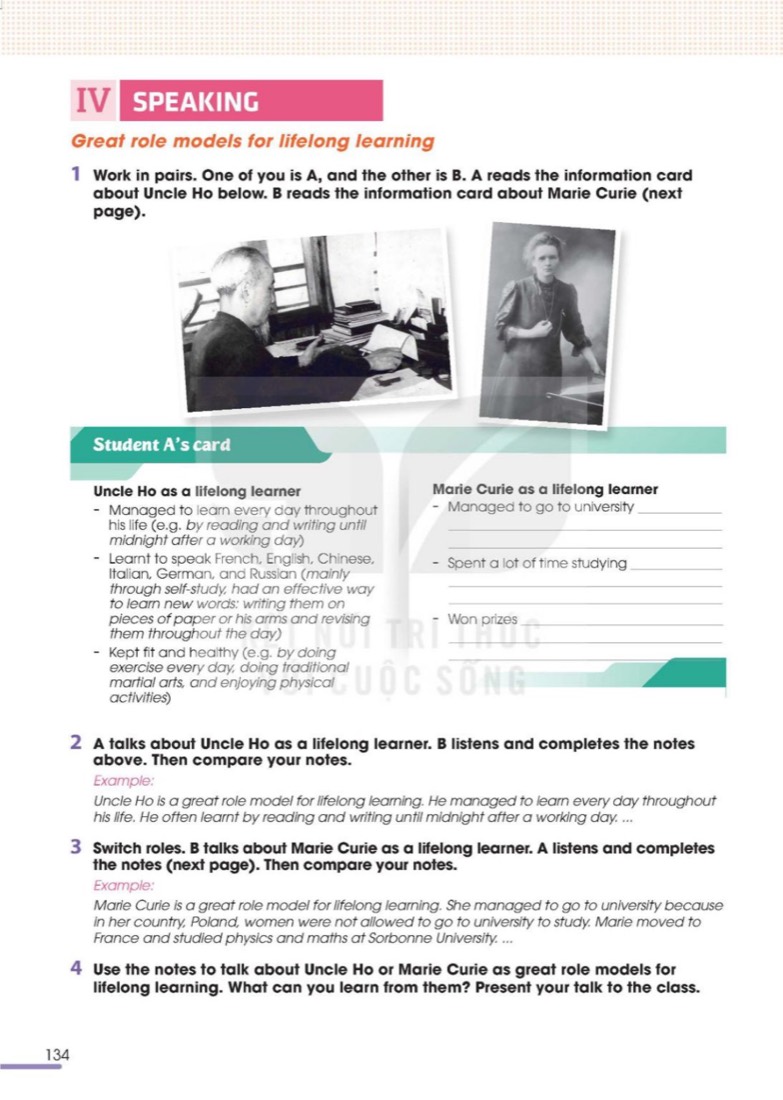
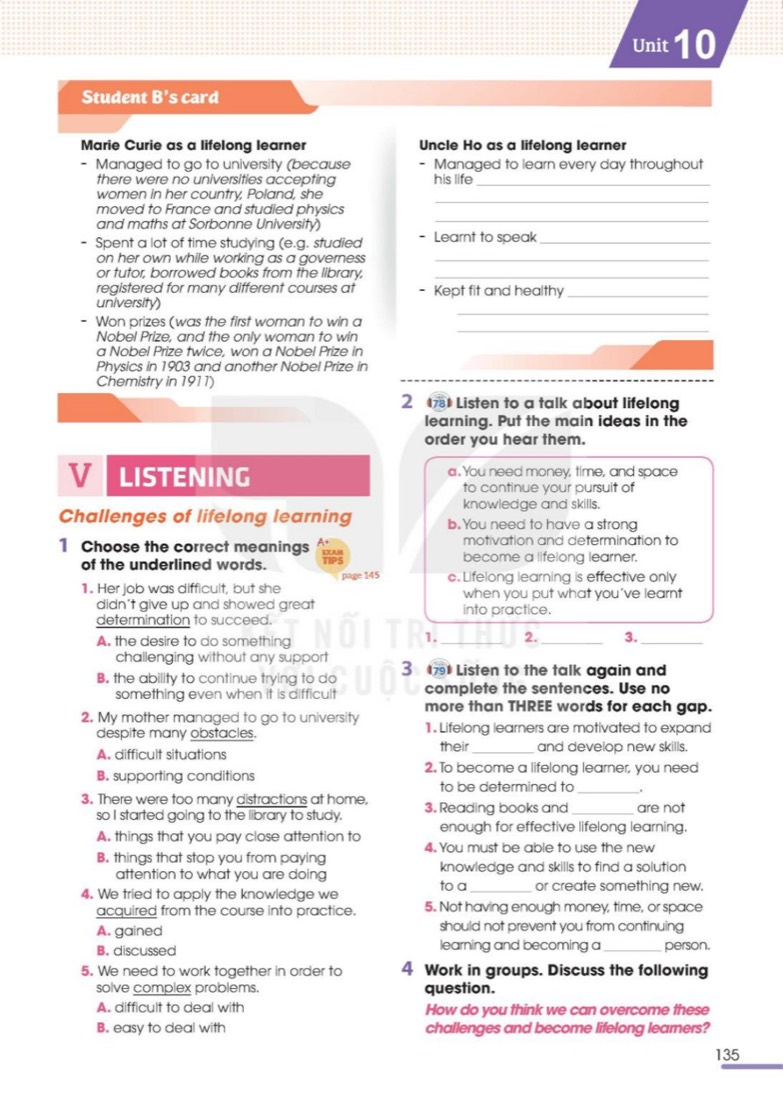
2. Ngữ liệu bài nói: Hai tấm gương sáng về học tập suốt đời
Nội dung bài nói xoay quanh hai nhân vật vĩ đại: Chủ tịch Hồ Chí Minh (Uncle Ho) và nhà khoa học Marie Curie. Dưới đây là thông tin chi tiết từ thẻ của học sinh A (Student A's card) và thẻ của học sinh B (Student B's card) kèm bản dịch tiếng Việt song song.
| Nguyên văn tiếng Anh (Student Cards) | Bản dịch tiếng Việt |
|---|---|
| 1. Uncle Ho as a lifelong learner (Bác Hồ - tấm gương học tập suốt đời) | |
|
|
| 2. Marie Curie as a lifelong learner (Marie Curie - tấm gương học tập suốt đời) | |
|
|
3. Từ vựng trọng tâm trong bài nói
Để diễn đạt mạch lạc và tự tin khi thuyết trình, các em cần nắm chắc các từ và cụm từ xuất hiện trong bài:
| Từ vựng / Cụm từ | Phiên âm IPA | Từ loại | Nghĩa tiếng Việt | Ví dụ trong bài |
|---|---|---|---|---|
| role model | /ˈrəʊl mɒdl/ | noun | hình mẫu, tấm gương noi theo | Uncle Ho is a great role model for lifelong learning. |
| lifelong learner | /ˌlaɪflɒŋ ˈlɜːnə(r)/ | noun | người học tập suốt đời | Marie Curie as a lifelong learner. |
| throughout | /θruːˈaʊt/ | prep. | suốt, trong suốt (thời gian) | He managed to learn every day throughout his life. |
| self-study | /ˌself ˈstʌdi/ | noun | sự tự học | He learnt six languages mainly through self-study. |
| martial arts | /ˌmɑːʃl ˈɑːts/ | noun | võ thuật | He kept fit by doing traditional martial arts. |
| governess | /ˈɡʌvənəs/ | noun | nữ gia sư, cô giáo dạy trẻ tại gia | She studied on her own while working as a governess or tutor. |
| tutor | /ˈtjuːtə(r)/ | noun | gia sư, người dạy kèm | She earned a living working as a tutor. |
| register | /ˈredʒɪstə(r)/ | verb | đăng ký (khóa học, môn học) | She registered for many different courses at university. |
| revise | /rɪˈvaɪz/ | verb | ôn tập, xem lại (kiến thức) | He wrote new words on his arms and revised them throughout the day. |
4. Cấu trúc ngữ pháp & mẫu câu hữu ích cho bài nói
Khi trình bày về một nhân vật truyền cảm hứng học tập suốt đời, các em hãy áp dụng các cấu trúc then chốt sau:
1. Giới thiệu tấm gương học tập:
- S + is a great role model for lifelong learning.
Ví dụ: Marie Curie is a great role model for lifelong learning. (Marie Curie là một tấm gương sáng về tinh thần học tập suốt đời.)
2. Diễn tả nỗ lực vượt qua khó khăn để đạt mục tiêu:
- S + managed to + V (nguyên thể): xoay xở thành công / vượt khó để làm được việc gì.
Ví dụ: She managed to go to university because there were no universities accepting women in her country. (Bà đã cố gắng theo học đại học vì ở quê hương bà không có trường đại học nào nhận nữ giới.)
3. Diễn tả cách thức, phương pháp học tập:
- By + V-ing: bằng cách làm việc gì.
Ví dụ: He often learnt by reading and writing until midnight after a working day. (Bác thường học bằng cách đọc và viết đến tận nửa đêm sau một ngày làm việc.) - Through + N / V-ing: thông qua điều gì.
Ví dụ: He learnt to speak six languages mainly through self-study. (Bác đã học nói 6 thứ tiếng chủ yếu qua việc tự học.) - Spend + time + V-ing: dành thời gian làm việc gì.
Ví dụ: Marie Curie spent a lot of time studying on her own. (Marie Curie đã dành rất nhiều thời gian để tự học.)
4. Nêu bài học rút ra cho bản thân (What can you learn from them?):
- From his/her story, I have learnt that + mệnh đề: Từ câu chuyện của Bác/bà, em học được rằng...
- He/She inspires me to + V (nguyên thể): Người đó truyền cảm hứng cho em...
- Ví dụ: Uncle Ho inspires me to form a daily self-study habit and keep fit. (Bác Hồ truyền cảm hứng cho em hình thành thói quen tự học hàng ngày và rèn luyện thể chất.)
5. Hướng dẫn làm bài tập SGK Speaking
Task 1: Work in pairs. One of you is A, and the other is B. A reads the information card about Uncle Ho below. B reads the information card about Marie Curie (next page).
Yêu cầu: Làm việc theo cặp. Một bạn là A, một bạn là B. Học sinh A đọc thẻ thông tin về Bác Hồ ở trang 134. Học sinh B đọc thẻ thông tin về Marie Curie ở trang 135.
Cách thực hiện:
- Học sinh A chú ý 3 thông tin của Bác Hồ: việc học hàng ngày, khả năng ngoại ngữ & cách học từ vựng, việc giữ gìn sức khỏe.
- Học sinh B chú ý 3 thông tin của Marie Curie: việc học đại học ở Pháp, thời gian tự học & đăng ký khóa học, các giải thưởng Nobel danh giá.
Task 2: A talks about Uncle Ho as a lifelong learner. B listens and completes the notes above. Then compare your notes.
Yêu cầu: Học sinh A nói về Bác Hồ như một tấm gương học tập suốt đời. Học sinh B lắng nghe và điền vào các dòng trống trên thẻ của mình (Student B's card - trang 135). Sau đó so sánh lại phần ghi chú.
Gợi ý bài nói của học sinh A:
"Uncle Ho is a great role model for lifelong learning. He managed to learn every day throughout his life. He often learnt by reading and writing until midnight after a working day. Besides, he learnt to speak French, English, Chinese, Italian, German, and Russian, mainly through self-study. He had a very effective way to learn new words: writing them on pieces of paper or his arms and revising them throughout the day. Finally, he always kept fit and healthy by doing exercise every day, doing traditional martial arts, and enjoying physical activities."
Đáp án điền vào thẻ của học sinh B (Student B's card - phần Uncle Ho):
- Managed to learn every day throughout his life: (e.g. by reading and writing until midnight after a working day)
- Learnt to speak: French, English, Chinese, Italian, German, and Russian (mainly through self-study, had an effective way to learn new words: writing them on pieces of paper or his arms and revising them throughout the day)
- Kept fit and healthy: (e.g. by doing exercise every day, doing traditional martial arts, and enjoying physical activities)
Task 3: Switch roles. B talks about Marie Curie as a lifelong learner. A listens and completes the notes (next page). Then compare your notes.
Yêu cầu: Đổi vai. Học sinh B nói về Marie Curie như một tấm gương học tập suốt đời. Học sinh A lắng nghe và hoàn thành các dòng trống trên thẻ của mình (Student A's card - trang 134). Sau đó so sánh lại phần ghi chú.
Gợi ý bài nói của học sinh B:
"Marie Curie is a great role model for lifelong learning. She managed to go to university because in her country, Poland, women were not allowed to go to university to study. Marie moved to France and studied physics and maths at Sorbonne University. In addition, she spent a lot of time studying; she studied on her own while working as a governess or tutor, borrowed books from the library, and registered for many different courses at university. Lastly, she won great prizes: she was the first woman to win a Nobel Prize, and the only woman to win a Nobel Prize twice, winning a Nobel Prize in Physics in 1903 and another Nobel Prize in Chemistry in 1911."
Đáp án điền vào thẻ của học sinh A (Student A's card - phần Marie Curie):
- Managed to go to university: (because there were no universities accepting women in her country, Poland, she moved to France and studied physics and maths at Sorbonne University)
- Spent a lot of time studying: (e.g. studied on her own while working as a governess or tutor, borrowed books from the library, registered for many different courses at university)
- Won prizes: (was the first woman to win a Nobel Prize, and the only woman to win a Nobel Prize twice, won a Nobel Prize in Physics in 1903 and another Nobel Prize in Chemistry in 1911)
Task 4: Use the notes to talk about Uncle Ho or Marie Curie as great role models for lifelong learning. What can you learn from them? Present your talk to the class.
Yêu cầu: Sử dụng các ghi chú để nói về Bác Hồ hoặc Marie Curie như những tấm gương lớn về việc học tập suốt đời. Bạn học được điều gì từ họ? Trình bày bài nói trước lớp.
Dàn ý chuẩn cho bài nói:
- Introduction: Giới thiệu người bạn muốn nói đến (Uncle Ho hoặc Marie Curie) và khẳng định họ là tấm gương lớn về tinh thần học tập suốt đời.
- Main body: Trình bày chi tiết các dẫn chứng về tinh thần học tập từ phần ghi chú (nỗ lực học tập, phương pháp tự học, thành tựu).
- Lesson learnt: Trả lời câu hỏi What can you learn from them? (Bài học về tính kỷ luật, sự kiên trì, thói quen ghi chép, vượt lên khó khăn...).
- Conclusion: Câu kết tóm lược cảm nghĩ của em.
Bài nói mẫu 1: Về Chủ tịch Hồ Chí Minh (Uncle Ho)
"Good morning everyone. Today, I would like to talk about Uncle Ho as a great role model for lifelong learning.
Throughout his entire life, Uncle Ho managed to learn every single day. Even after an exhausting working day, he often stayed up reading and writing until midnight. What impresses me the most is his extraordinary language ability. He learnt to speak six foreign languages: French, English, Chinese, Italian, German, and Russian, mainly through self-study. He had a unique and effective way of expanding his vocabulary: writing new words on pieces of paper or on his arms so that he could revise them throughout the day. Alongside mental training, he never forgot to keep fit and healthy by exercising daily, practicing traditional martial arts, and taking part in physical activities.
From Uncle Ho, I have learnt two valuable lessons. First, self-study and continuous revision are the keys to mastering any new subject or language. Second, a healthy body is essential to maintain lifelong learning. I will definitely apply his word-memorizing method to improve my English vocabulary every day. Thank you for listening!"
Bài nói mẫu 2: Về nhà khoa học Marie Curie
"Hello teacher and classmates. Today, I would like to present Marie Curie as an inspirational role model for lifelong learning.
Marie Curie demonstrated an incredible passion for education. Because universities in Poland did not admit women, she was determined to move to France to study physics and mathematics at Sorbonne University. She spent an enormous amount of time studying. Even while working hard as a governess or tutor to earn a living, she continued studying on her own, borrowing books from libraries, and registering for numerous courses. Her continuous devotion led to historic achievements: she became the first woman to win a Nobel Prize and remains the only woman to win it twice—in Physics in 1903 and in Chemistry in 1911.
From Marie Curie, I have learnt that no barrier or gender prejudice should stop us from pursuing knowledge. Her story inspires me to stay focused, read more library books, and never give up on my academic goals despite difficult circumstances. Thank you for your attention!"
🌟 Em đã học (Ghi nhớ kiến thức trọng tâm)
- Cung cấp thông tin chi tiết và bản dịch song ngữ về tinh thần học tập suốt đời của Chủ tịch Hồ Chí Minh và nhà khoa học Marie Curie.
- Hệ thống từ vựng trọng tâm liên quan đến việc tự học, rèn luyện ngoại ngữ, nghiên cứu và học tập bền bỉ.
- Nắm vững các cấu trúc ngữ pháp thông dụng khi thuyết trình về tiểu sử và thói quen học tập: manage to do sth, by + V-ing, spend time doing sth.
- Hướng dẫn thực hành các hoạt động làm việc theo cặp (trao đổi thông tin, hoàn thành ghi chú) và bài nói mẫu chia sẻ bài học rút ra từ các tấm gương lớn.