Tiếng Anh lớp 12 · KNTT · Chương 9
Lý thuyết Tiếng Anh 12 Unit 7 · Writing (Description of pie charts)
Bài học hướng dẫn phương pháp và cấu trúc viết đoạn văn mô tả biểu đồ tròn (Description of pie charts) về các nguồn tin tức chính của các nhóm độ tuổi khác nhau trong Unit 7 Tiếng Anh 12 Global Success.
1. Trang sách giáo khoa
2. Bài viết mẫu và phân tích cấu trúc bài mô tả biểu đồ tròn
Dưới đây là văn bản mô tả biểu đồ tròn hoàn chỉnh từ bài học (so sánh nguồn tin tức của thanh niên và người cao tuổi), kèm bản dịch song song giúp học sinh nắm rõ cách triển khai câu văn:
| Nguyên văn Tiếng Anh | Bản dịch Tiếng Việt |
|---|---|
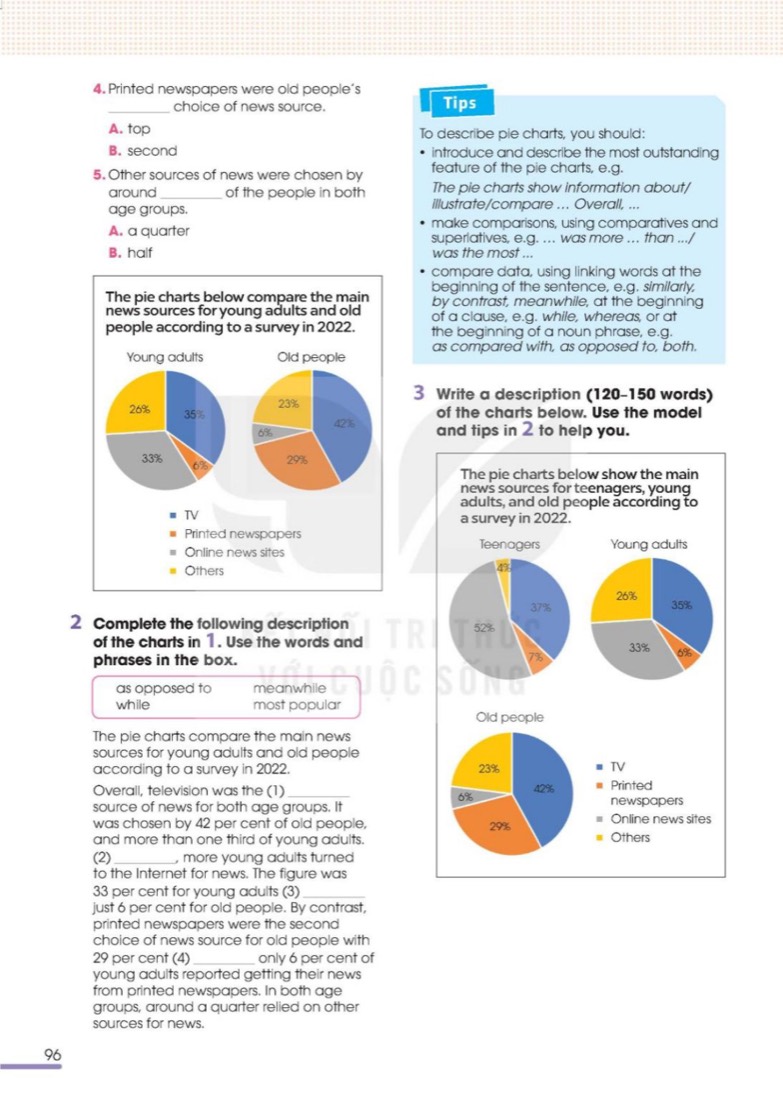
| The pie charts compare the main news sources for young adults and old people according to a survey in 2022. | Các biểu đồ tròn so sánh các nguồn tin tức chính đối với người trẻ tuổi và người cao tuổi theo một cuộc khảo sát vào năm 2022. |
| Overall, television was the most popular source of news for both age groups. It was chosen by 42 per cent of old people, and more than one third of young adults. | Nhìn chung, truyền hình là nguồn tin tức phổ biến nhất đối với cả hai nhóm tuổi. Nó được lựa chọn bởi 42 phần trăm người cao tuổi và hơn một phần ba người trẻ tuổi. |
| Meanwhile, more young adults turned to the Internet for news. The figure was 33 per cent for young adults as opposed to just 6 per cent for old people. | Trong khi đó, nhiều người trẻ tuổi tìm đến Internet để đọc tin tức hơn. Con số này là 33 phần trăm ở người trẻ tuổi, trái ngược với chỉ 6 phần trăm ở người cao tuổi. |
| By contrast, printed newspapers were the second choice of news source for old people with 29 per cent while only 6 per cent of young adults reported getting their news from printed newspapers. | Ngược lại, báo in là lựa chọn nguồn tin thứ hai của người cao tuổi với 29 phần trăm, trong khi chỉ có 6 phần trăm người trẻ tuổi cho biết họ nhận tin tức từ báo in. |
| In both age groups, around a quarter relied on other sources for news. | Ở cả hai nhóm tuổi, khoảng một phần tư dựa vào các nguồn khác để cập nhật tin tức. |
Phân tích bố cục bài viết mô tả biểu đồ tròn:
- Introduction (Mở đầu): Giới thiệu nội dung biểu đồ biểu thị cái gì, đối tượng nào, thời gian nào (paraphrase lại đề bài).
- Overview (Tổng quan): Nêu đặc điểm nổi bật nhất (most outstanding feature) bao trùm các biểu đồ (ví dụ: nguồn tin nào chiếm tỷ lệ cao nhất ở cả hai nhóm).
- Body (Thân bài so sánh chi tiết): Nhóm các số liệu có tính chất tương phản hoặc tương đồng để so sánh, sử dụng các liên từ và cấu trúc so sánh thích hợp.
3. Bảng từ vựng và cụm từ chỉ số liệu quan trọng
Bảng tổng hợp các từ vựng, liên từ và cách diễn đạt số liệu xuất hiện trong bài viết:
| Từ vựng / Cụm từ | Phiên âm IPA | Từ loại | Nghĩa tiếng Việt | Câu ví dụ trong bài |
|---|---|---|---|---|
| pie chart | /ˈpaɪ tʃɑːt/ | noun | biểu đồ tròn | The pie charts compare the main news sources... |
| news source | /njuːz sɔːs/ | noun | nguồn tin tức | Television was the most popular source of news for both age groups. |
| printed newspaper | /ˈprɪntɪd ˈnjuːzpeɪpə(r)/ | noun | báo in, báo giấy | Printed newspapers were the second choice of news source for old people. |
| online news site | /ˈɒnlaɪn njuːz saɪt/ | noun | trang tin tức trực tuyến | Which news source was least popular among old people? Online news sites. |
| meanwhile | /ˈmiːnwaɪl/ | adverb | trong khi đó | Meanwhile, more young adults turned to the Internet for news. |
| by contrast | /baɪ ˈkɒntrɑːst/ | idiom | ngược lại, trái lại | By contrast, printed newspapers were the second choice for old people. |
| as opposed to | /əz əˈpəʊzd tuː/ | preposition | trái ngược với, thay vì | The figure was 33 per cent for young adults as opposed to just 6 per cent for old people. |
| rely on | /rɪˈlaɪ ɒn/ | phrasal verb | dựa vào, phụ thuộc vào | In both age groups, around a quarter relied on other sources for news. |
| turn to | /tɜːn tuː/ | phrasal verb | tìm đến, chuyển sang dùng | More young adults turned to the Internet for news. |
| a quarter | /ə ˈkwɔːtə(r)/ | noun | một phần tư (25%) | Around a quarter of the people in both age groups. |
| one third | /wʌn θɜːd/ | noun | một phần ba (~33.3%) | It was chosen by more than one third of young adults. |
4. Kỹ thuật viết bài và cấu trúc so sánh số liệu (Writing Tips)
Theo hướng dẫn mục Tips trong SGK (trang 96), để mô tả biểu đồ tròn chính xác và đạt điểm cao, học sinh cần áp dụng các kỹ thuật sau:
1. Giới thiệu và nêu đặc điểm nổi bật (Introduction & Overview)
- Câu mở đầu giới thiệu:
The pie charts show information about / illustrate / compare... (Các biểu đồ tròn thể hiện thông tin về / minh họa / so sánh...) - Câu nêu xu hướng tổng quan:
Overall, [S] was the most popular / largest / highest... (Nhìn chung, ... là phổ biến nhất / lớn nhất...)
2. Sử dụng cấp so sánh (Comparatives & Superlatives)
- So sánh hơn: ... was more popular than ..., ... had a higher percentage than ...
- So sánh nhất: ... was the most popular source ..., ... was the least popular among ...
3. Vị trí và cách dùng các liên từ so sánh (Linking words for comparing data)
| Vị trí ngữ pháp | Từ / Cụm từ liên kết | Ví dụ áp dụng |
|---|---|---|
| Đầu câu (ngăn cách bằng dấu phẩy) | Similarly, By contrast, Meanwhile | Meanwhile, more young adults turned to the Internet for news. By contrast, printed newspapers were the second choice for old people. |
| Đầu mệnh đề (nối 2 mệnh đề độc lập) | while, whereas | ...with 29 per cent while only 6 per cent of young adults reported getting their news from printed newspapers. |
| Đầu cụm danh từ | as compared with, as opposed to, both | The figure was 33 per cent for young adults as opposed to just 6 per cent for old people. |
5. Hướng dẫn giải chi tiết bài tập SGK
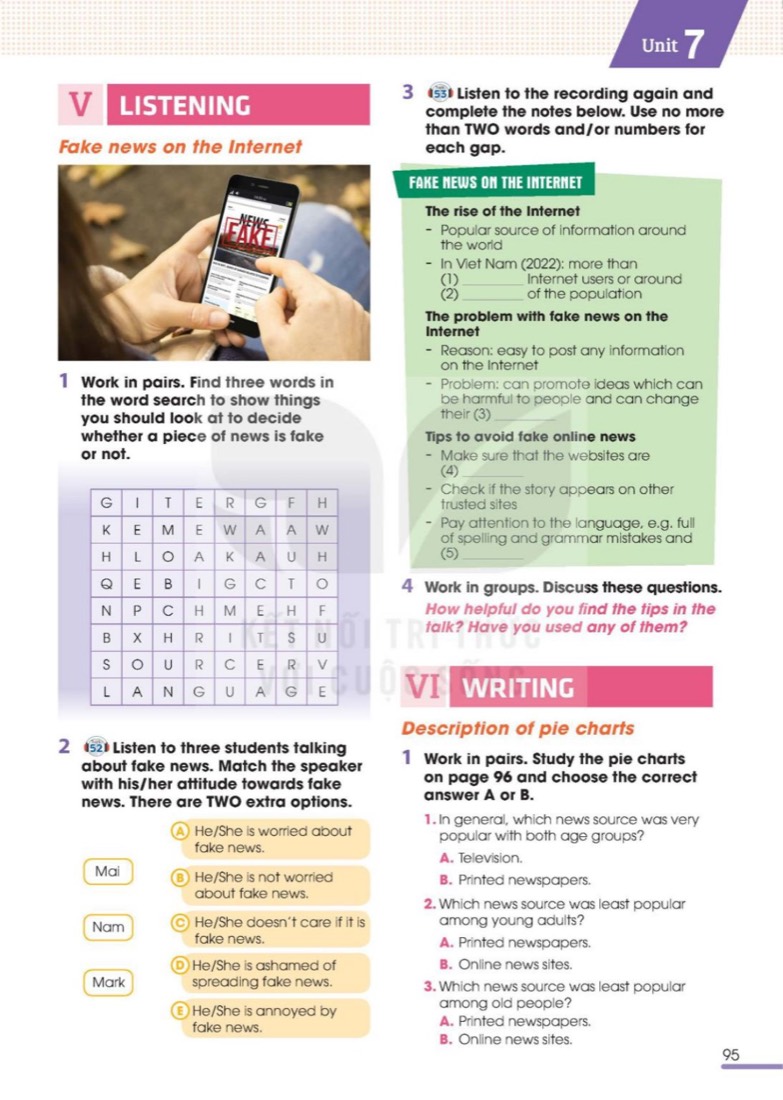
Bài 1 (Trang 95 - 96): Study the pie charts on page 96 and choose the correct answer A or B.
(Làm việc theo cặp. Nghiên cứu các biểu đồ tròn ở trang 96 và chọn câu trả lời đúng A hoặc B.)
- 1. In general, which news source was very popular with both age groups?
- A. Television. | B. Printed newspapers.
Đáp án: A. Television
Giải thích: Số liệu TV chiếm 35% ở người trẻ và 42% ở người cao tuổi (đều là tỷ lệ cao nhất trong mỗi nhóm). Trong khi đó, báo in chỉ chiếm 6% ở người trẻ. - 2. Which news source was least popular among young adults?
- A. Printed newspapers. | B. Online news sites.
Đáp án: A. Printed newspapers
Giải thích: Ở nhóm người trẻ (Young adults), Printed newspapers chỉ chiếm 6% (thấp nhất), trong khi Online news sites chiếm tới 33%. - 3. Which news source was least popular among old people?
- A. Printed newspapers. | B. Online news sites.
Đáp án: B. Online news sites
Giải thích: Ở nhóm người cao tuổi (Old people), Online news sites chỉ chiếm 6% (thấp nhất), còn Printed newspapers chiếm 29%. - 4. Printed newspapers were old people's _______ choice of news source.
- A. top | B. second
Đáp án: B. second
Giải thích: Nguồn tin đứng đầu của người già là TV (42%), báo in (Printed newspapers) đứng thứ hai với 29%. - 5. Other sources of news were chosen by around _______ of the people in both age groups.
- A. a quarter | B. half
Đáp án: A. a quarter
Giải thích: Mục Others chiếm 26% ở người trẻ và 23% ở người già; cả hai con số này đều xấp xỉ 25% (tức một phần tư - a quarter).
Bài 2 (Trang 96): Complete the following description of the charts in 1. Use the words and phrases in the box.
(Hoàn thành đoạn văn mô tả các biểu đồ ở bài 1 sau đây. Sử dụng các từ và cụm từ trong khung.)
Từ trong khung: as opposed to | meanwhile | while | most popular
- Vị trí (1): most popular → Cụm từ cần tính từ so sánh nhất đứng trước danh từ: "the most popular source of news" (nguồn tin phổ biến nhất).
- Vị trí (2): Meanwhile → Đứng ở đầu câu, ngăn cách bởi dấu phẩy để chuyển tiếp sang một đối tượng so sánh khác: "Meanwhile, more young adults turned to the Internet...".
- Vị trí (3): as opposed to → Đứng trước cụm danh từ chỉ số liệu tương phản: "33 per cent for young adults as opposed to just 6 per cent for old people".
- Vị trí (4): while → Liên từ nối hai mệnh đề diễn tả sự tương phản: "with 29 per cent while only 6 per cent of young adults reported...".
Bài 3 (Trang 96): Write a description (120–150 words) of the charts below. Use the model and tips in 2 to help you.
(Viết một bài mô tả 120–150 từ về các biểu đồ bên dưới. Sử dụng bài mẫu và các mẹo ở bài 2 để hỗ trợ bạn.)
Số liệu phân tích từ 3 biểu đồ:
- Teenagers: Online news sites: 52%, TV: 37%, Printed newspapers: 7%, Others: 4%.
- Young adults: TV: 35%, Online news sites: 33%, Others: 26%, Printed newspapers: 6%.
- Old people: TV: 42%, Printed newspapers: 29%, Others: 23%, Online news sites: 6%.
Bài viết tham khảo mẫu chuẩn (147 từ):
The pie charts compare the main news sources for teenagers, young adults, and old people according to a survey in 2022.
Overall, online news sites and television were the most popular sources, whereas printed newspapers were least preferred by the young.
Specifically, online news sites were the top choice for teenagers at 52 per cent and one third of young adults, as opposed to just 6 per cent of old people. Meanwhile, television was popular among all three groups, chosen by 42 per cent of old people, 37 per cent of teenagers, and 35 per cent of young adults.
By contrast, printed newspapers were the second choice for old people with 29 per cent, while only 7 per cent of teenagers and 6 per cent of young adults used them. Lastly, around a quarter of young adults and old people relied on other sources, compared with only 4 per cent of teenagers.
Bản dịch bài mẫu:
Các biểu đồ tròn so sánh các nguồn tin tức chính đối với thanh thiếu niên, người trẻ tuổi và người cao tuổi theo một cuộc khảo sát vào năm 2022. Nhìn chung, các trang tin trực tuyến và truyền hình là những nguồn phổ biến nhất, trong khi báo in ít được giới trẻ ưa chuộng nhất. Cụ thể, các trang tin tức trực tuyến là lựa chọn hàng đầu của thanh thiếu niên ở mức 52% và một phần ba người trẻ tuổi, trái ngược với chỉ 6% ở người cao tuổi. Trong khi đó, truyền hình lại phổ biến ở cả ba nhóm, được lựa chọn bởi 42% người già, 37% thanh thiếu niên và 35% người trẻ. Ngược lại, báo in là lựa chọn thứ hai của người cao tuổi với 29%, trong khi chỉ có 7% thanh thiếu niên và 6% người trẻ tuổi sử dụng chúng. Cuối cùng, khoảng một phần tư người trẻ tuổi và người già dựa vào các nguồn khác, so với chỉ 4% ở thanh thiếu niên.
🌟 Em đã học (Ghi nhớ kiến thức trọng tâm)
- Nắm vững bố cục chuẩn của một bài mô tả biểu đồ tròn gồm: Giới thiệu (Introduction), Xu hướng tổng quan nổi bật (Overview) và Thân bài so sánh số liệu chi tiết (Body).
- Sử dụng thành thạo cấu trúc so sánh hơn (comparatives) và so sánh nhất (superlatives) để làm nổi bật sự chênh lệch giữa các số liệu.
- Làm chủ các từ và cụm từ liên kết dùng để so sánh số liệu: 'meanwhile', 'by contrast', 'similarly', 'while', 'whereas', 'as opposed to', 'as compared with'.
- Học cách diễn đạt linh hoạt tỷ lệ phần trăm (per cent, a quarter, more than one third) để tránh lặp từ trong bài viết học thuật.